Pika vs ChatGPT: Which Is Better?
Compare Pika and ChatGPT for AI video, creative effects, ideation, scripts, research, images, workflow breadth, pricing, rights, and team use.
Direct answer
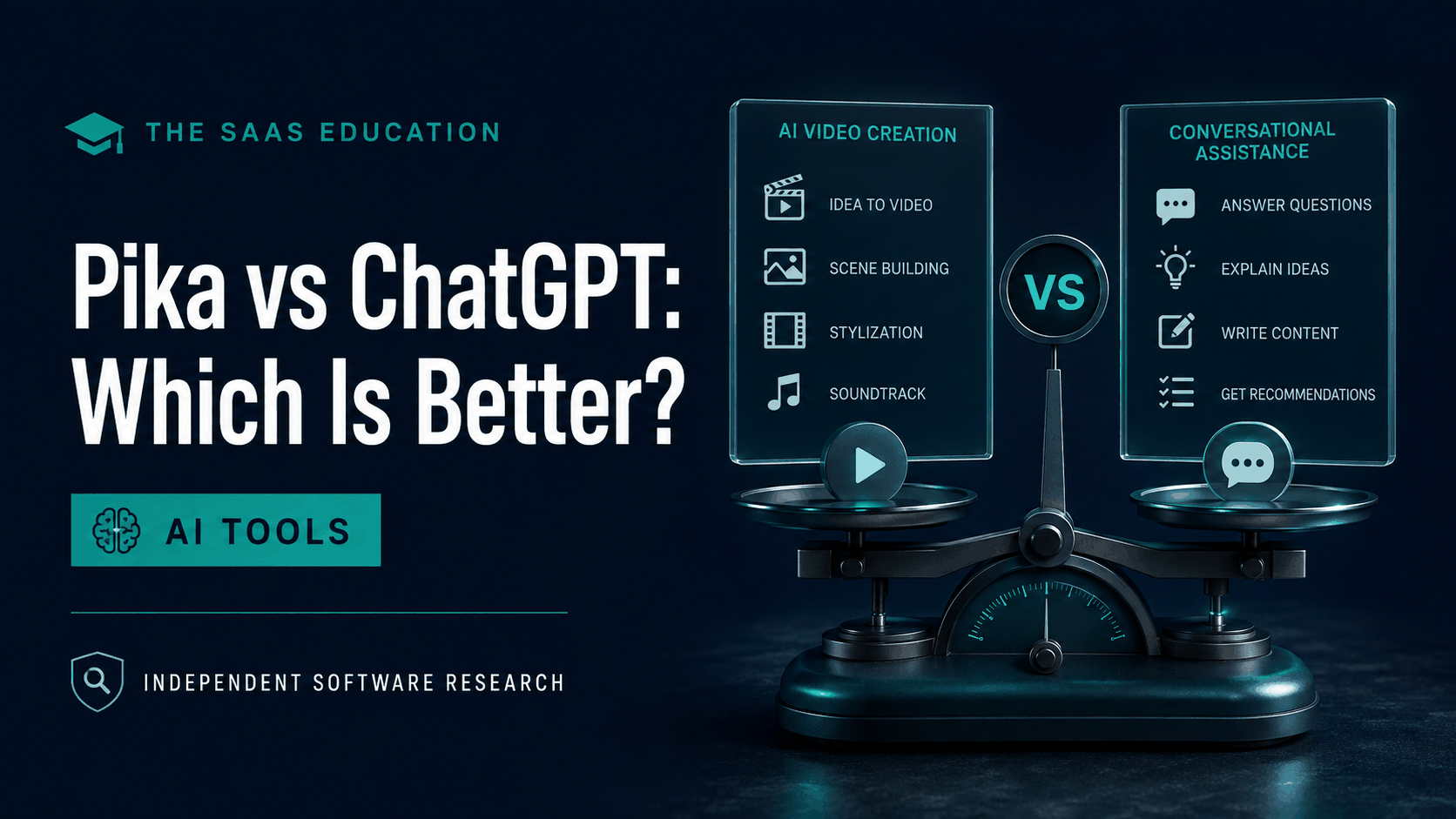
Pika is better when the central task is generating short AI video clips or applying purpose-built creative video effects. ChatGPT is better when the task spans research, ideation, scripts, writing, files, analysis, images, coding, and general production support.
This is not a like-for-like comparison. Pika is a specialist creative product. ChatGPT is a broad AI workspace, while OpenAI’s dedicated video experience is Sora. A creator may use ChatGPT to develop a concept and script, then use Pika to produce visual variations. The right decision depends on where the real bottleneck sits.
Do not choose from a single impressive demo. Test representative prompts, count credits and retries, inspect output consistency, include editing and review time, and compare the cost per accepted clip or completed campaign asset.
Pika vs ChatGPT at a glance
| Area | Pika | ChatGPT |
|---|---|---|
| Primary orientation | Specialist AI video creation and effects | General-purpose AI workspace |
| Best for | Short visual clips, transformations, and creative experiments | Research, scripts, briefs, analysis, files, images, coding, and planning |
| Video workflow | Core product experience | Video relates to OpenAI’s separate/current Sora experience |
| Text work | Supporting role | Major strength |
| Research | Not the central proposition | Web search and plan-dependent research workflows |
| Cost model | Plan-dependent video credits and features | Subscription tiers with plan-dependent access and limits |
| Main risk | Spending credits on unusable generations | Treating fluent output as verified fact or finished work |
| Best buying method | Test cost per accepted clip | Test time saved per accepted workflow |
What Pika is
Pika presents itself as a creative platform for AI video, workflow automation, agents, and experiments. Its main interface invites users to create AI videos, while its product pages describe named tools and effects whose access varies by plan.
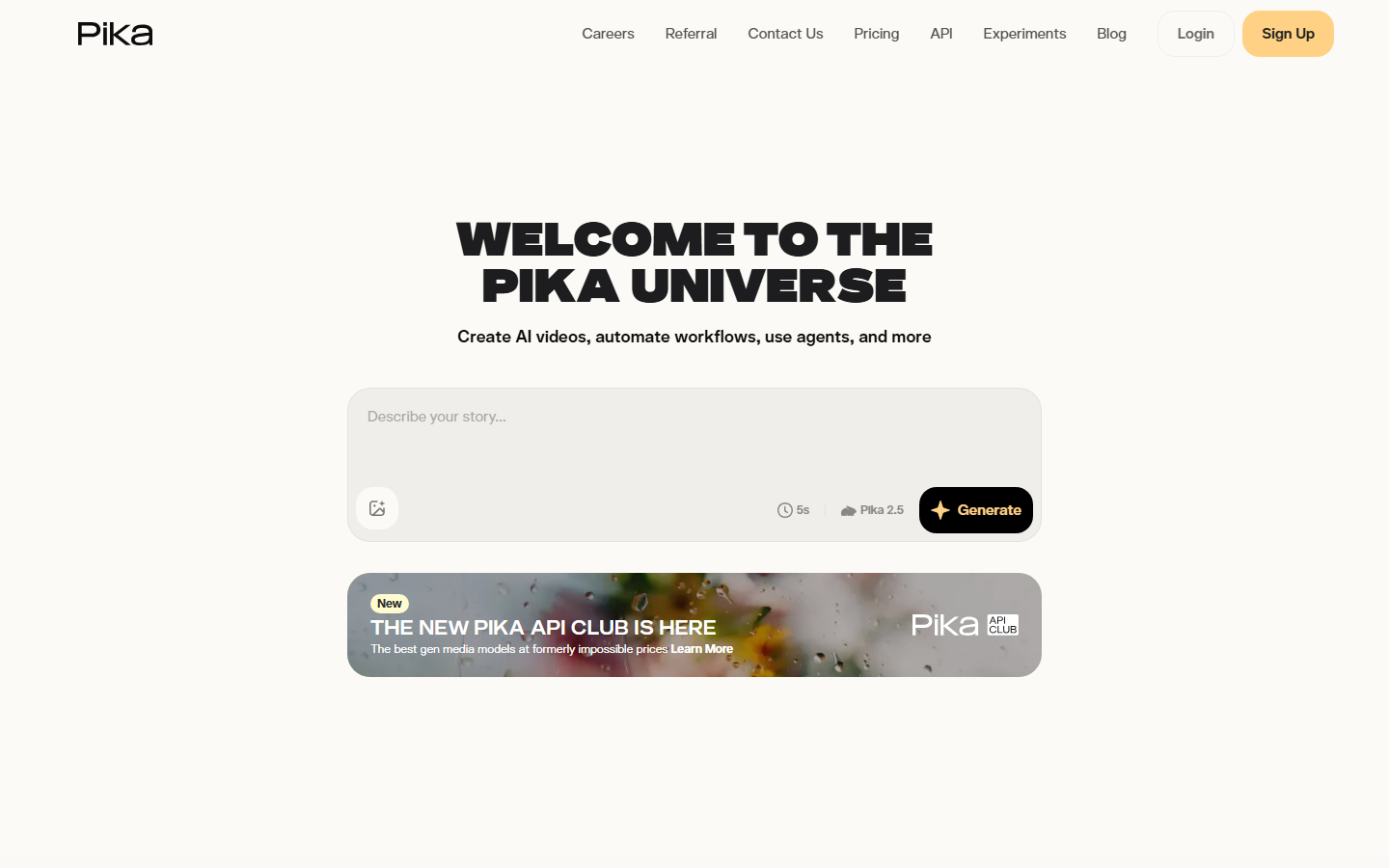
The current Pika experience is useful for people who already know that the output should be visual motion. The starting point can be a text idea, an image, or another supported creative input. The objective is generally a generated or transformed clip rather than a long written deliverable.
Pika’s pricing is credit-based. That matters because the sticker price alone does not describe production cost. Resolution, model, duration, effect, retry rate, and plan can affect how much useful work a credit allowance produces.
What ChatGPT is
ChatGPT is OpenAI’s general-purpose AI workspace. It supports conversational work across research, web search, files, writing, data analysis, images, voice, projects, Canvas, and coding-related tasks, with capabilities varying by plan and current product state.
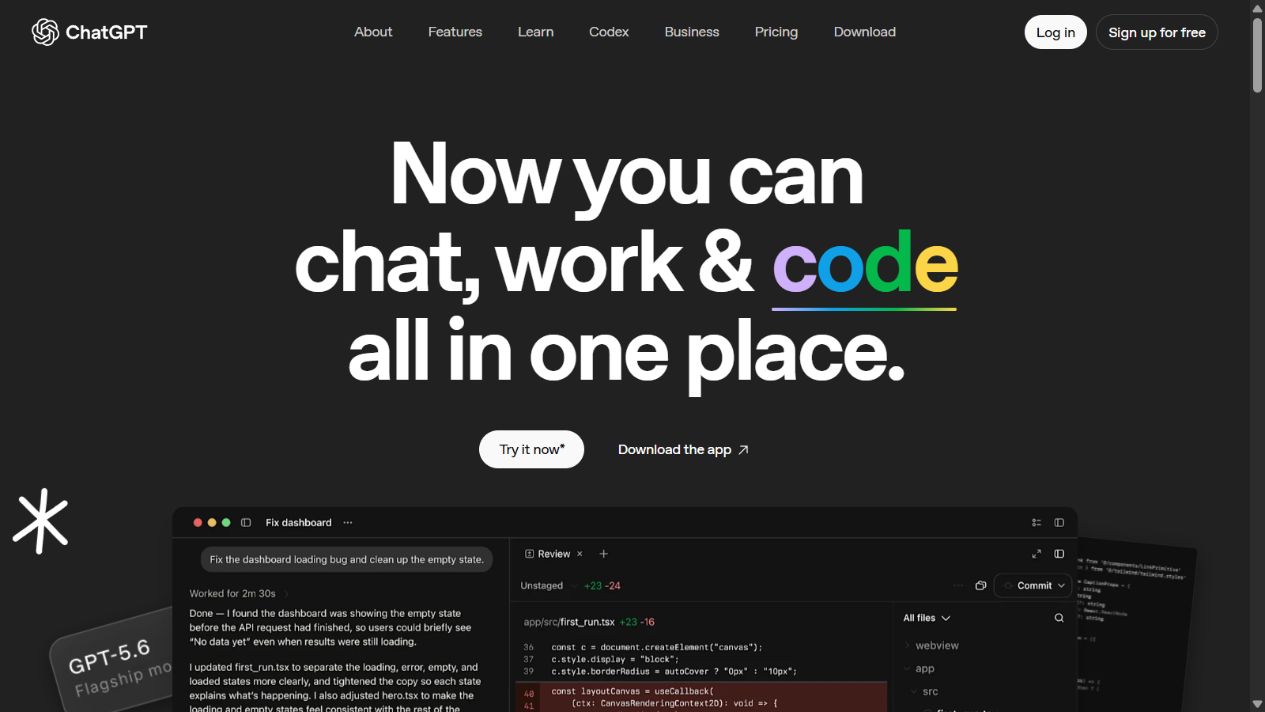
For a video project, ChatGPT can help define an audience, research a topic, develop a concept, create a shot list, draft narration, revise a prompt, prepare captions, or analyze campaign information. OpenAI also operates Sora for video generation, so buyers should inspect current Sora access instead of assuming that every ChatGPT screen or plan includes the same video workflow.
ChatGPT’s advantage is continuity across stages. Its disadvantage is that broad capability can obscure the need for specialist production controls and disciplined verification.
AI video generation
Pika is the more direct specialist
Pika wins when a user wants to enter a creative prompt, choose a video-oriented control, generate variations, and iterate visually. The official product surface emphasizes video and effects rather than asking the user to adapt a general chat tool to the task.
Its named capabilities include Pika 2.5 access and tools such as Pikascenes, Pikadditions, Pikaswaps, Pikatwists, and Pikaffects, subject to current plan rules. These names describe different creative operations, but buyers should verify exact inputs, resolutions, availability, and credit costs on the live pricing page.
ChatGPT supports the wider creative process
ChatGPT is stronger before and after generation. It can turn a campaign objective into concepts, critique a storyboard, produce prompt variants, rewrite narration for different durations, and create a review checklist. That surrounding work can be more time-consuming than the initial clip.
Video generation itself should be evaluated through OpenAI’s current Sora product and terms. Product packaging changes, so avoid relying on old assumptions about duration, resolution, watermarks, or inclusion in a particular plan.
Creative control and iteration
Pika’s focused tools make it easier to communicate a specific kind of visual transformation. A specialist interface can reduce prompt complexity because the chosen operation already constrains the task.
ChatGPT offers a different kind of control: language-based reasoning and iteration. It can help articulate camera movement, mood, sequence, audience, brand constraints, and continuity requirements. It may also identify why a prompt is ambiguous and propose controlled variations.
Neither approach guarantees consistent characters, physics, typography, products, or brand details across generations. Run a representative test set that includes the hardest expected material, not only scenic or forgiving prompts.
Research, scripting, and planning
ChatGPT is the clear choice when the video begins with information. A training clip, product explainer, educational short, or campaign needs factual source material, structure, and language before visual generation begins.
Use primary sources, ask the system to distinguish evidence from inference, and verify every consequential statement. ChatGPT can accelerate synthesis, but it can still misread or invent support.
Pika is not positioned as a broad research environment. It can participate later in the process once the concept and inputs are ready. Using each product for its strongest stage is often more practical than forcing one subscription to cover everything.
Editing and final production
Generated video is usually an ingredient, not a finished asset. A publishable result may still require:
- clip selection and sequencing;
- trimming, transitions, and pacing;
- narration, music, and sound design;
- captions and accessibility review;
- color and brand consistency;
- rights, consent, and disclosure checks;
- platform-specific exports and quality assurance.
Pika can generate or transform material, but buyers should not assume it replaces a full nonlinear editor or production system. ChatGPT can help with instructions, metadata, and review but does not remove the need for visual judgment.
Pricing and value
Pika and ChatGPT use different value units. Pika’s practical denominator is often accepted clips per credit allowance. ChatGPT’s denominator is accepted hours or deliverables across many workflows.
For Pika, calculate:
Monthly production cost ÷ accepted clips = cost per accepted clip
Include failed generations, reruns, upscaling, editing, storage, music, voice, and human review. A low subscription with a high rejection rate can be expensive.
For ChatGPT, calculate:
Subscription + review + administration − conservative value of accepted time saved
Do not count prompts, generated words, or raw variants as value. Count completed briefs, approved scripts, finished analyses, or other outputs that would otherwise consume accountable work.
If both tools are used, measure the combined pipeline. Two subscriptions are justified only if they remove different bottlenecks.
Output quality
We do not declare a universal quality winner because this article is based on official-source research, not a controlled generation benchmark. AI video quality depends heavily on prompt, subject, movement, model, settings, duration, and selection bias.
Create a ten-prompt test covering the intended workload. Include people, hands, text, products, camera movement, reference images, recurring characters, and branded elements where relevant. Score each output blind where possible for instruction adherence, visual defects, temporal stability, identity consistency, editability, and time to acceptance.
The winning tool is the one that reaches the required standard reliably at an acceptable total cost, not the one that produces the most dramatic showcase clip.
Commercial rights and responsible use
Review the current terms for the exact plan and workflow. Consider ownership and license language, commercial-use conditions, input rights, output restrictions, model releases, likeness consent, trademarks, music, disclosure requirements, and client contracts.
Do not upload material you are not authorized to use. Do not create deceptive impersonations or present synthetic scenes as documentary evidence. Keep records of prompts, source assets, approvals, and generation dates for commercial projects.
OpenAI describes provenance measures for Sora outputs, while Pika maintains its own terms and acceptable-use policies. These controls are relevant but do not transfer legal or ethical responsibility away from the publisher.
Which should creators choose?
Choose Pika when:
- short generated video is the primary deliverable;
- purpose-built effects match the creative brief;
- the team can manage a credit-based iteration process;
- final editing and rights review are already covered.
Choose ChatGPT when:
- research, scripting, planning, writing, or analysis dominates the workload;
- one assistant must support several kinds of work;
- the team values files, projects, data, images, coding, or web research;
- video generation is occasional or handled elsewhere.
Consider both when a repeatable pipeline uses ChatGPT for evidence, concept development, scripts, prompts, captions, and review, while Pika creates the visual clips. Pilot that workflow before committing to both plans.
Which should businesses choose?
A business should begin with governance. Define approved users, data classes, source materials, output disclosures, brand review, rights clearance, retention, and who owns final approval.
Pika can fit a creative team that needs rapid visual experimentation. ChatGPT can fit a wider set of departments, but broad access increases the importance of acceptable-use rules and training. Individual and organizational plans may provide different controls, so do not treat a personal subscription as a substitute for a formal deployment decision.
For regulated, political, medical, financial, legal, or safety-related media, apply stricter review and consider whether synthetic video is appropriate at all.
Prompt workflow: specialist control versus conversational development
The products encourage different prompting behavior. In Pika, the prompt is closely tied to a visual generation request. A useful brief names the subject, setting, action, camera behavior, visual treatment, timing, and elements that must remain stable. Reference material and the selected effect can carry part of that instruction.
In ChatGPT, the conversation can begin much earlier. A user might explore audience problems, reject weak concepts, convert one idea into a six-shot sequence, specify continuity rules, and ask for separate generation prompts. This deliberative stage helps when the brief is not yet ready for a video model.
Use a two-part prompt record for repeatability. The first part is the creative specification: objective, audience, message, required visual elements, prohibited elements, aspect ratio, duration, and brand rules. The second is the generation instruction for the selected tool. Keeping them separate makes it easier to revise strategy without losing production details.
Do not ask either product to infer important brand constraints. Provide approved colors, product appearance, pronunciation, copy, disclosure language, and reference assets explicitly. Generated lettering and precise product details deserve special inspection because visually plausible output may still be wrong.
Team workflow and handoff
A solo creator can tolerate an informal prompt history. A team needs traceability. Store the approved brief, source assets, prompt versions, selected outputs, edits, rights notes, and final approval in the team’s system of record.
Pika can sit in the generation stage, while ChatGPT can help produce planning and review artifacts. Neither should become the only location where a project decision exists. Chat histories are difficult substitutes for a production brief, asset library, project tracker, or approval system.
Define a naming convention before generating dozens of variants. Include project, scene, version, model or feature, aspect ratio, and date. Record why an output was rejected. This turns experimentation into useful evidence for the next prompt instead of an expanding folder of anonymous clips.
For client work, clarify whether the client may receive source prompts and generated variants, who is responsible for likeness or asset permissions, and what disclosure is required. The fastest generation workflow can still fail commercially if approval and rights handoffs are ambiguous.
Common failure modes
Selecting from demos instead of representative work
Vendor galleries show what a model can produce under favorable conditions. Your workload may involve exact products, recurring characters, small text, constrained layouts, or unusual motion. Test those cases directly.
Ignoring retry economics
One generation price is not the cost of one usable asset. If only one in eight clips meets the brief, the effective generation cost and review burden are much higher. Track accepted-output rate.
Confusing planning quality with rendering quality
ChatGPT may produce an excellent storyboard while the selected video model struggles to render it. Pika may create an attractive clip that does not communicate the campaign message. Score strategy and visual execution separately.
Publishing without accessibility work
Generated motion does not provide captions, transcripts, audio descriptions, readable contrast, or reduced-motion alternatives automatically. Add these requirements to the production checklist.
Automating before the workflow is stable
Pika presents API and automation paths, but automation multiplies both successes and mistakes. Stabilize prompts, moderation, file handling, cost limits, logging, and human approval before generating at scale.
Detailed pilot scorecard
Use a weighted scorecard that reflects the real deliverable:
| Criterion | Suggested weight | What to measure |
|---|---|---|
| Instruction adherence | 20% | Required subject, action, framing, and exclusions |
| Visual consistency | 15% | Identity, product, environment, and temporal stability |
| Creative usefulness | 15% | Whether the output advances the intended message |
| Time to accepted asset | 15% | Prompting, retries, review, editing, and export |
| Total cost | 10% | Subscription, credits, editing, storage, and labor |
| Editing compatibility | 10% | Export quality and ease of finishing elsewhere |
| Governance and rights | 10% | Data, permissions, terms, provenance, and approvals |
| Accessibility readiness | 5% | Ability to add captions, transcript, and alternatives |
Score each product on the same assignments. ChatGPT’s score may be strongest on planning and surrounding tasks, while Pika’s score concerns the generated clips. If comparing complete pipelines, include Sora or the actual ChatGPT-linked video route used during the test and state that boundary clearly.
Retain the unsuccessful outputs long enough to analyze patterns. Repeated failures are more informative than one lucky success. They reveal which subjects, movements, references, and constraints make the workflow expensive or unreliable.
A practical evaluation framework
- Define five to ten representative deliverables.
- Fix the source material, prompt objectives, duration, and acceptance standard.
- Record every generation, retry, credit, and editing minute.
- Score instruction adherence and recurring visual defects.
- Review rights, privacy, and plan terms for the intended use.
- Compare the complete path from idea to published asset.
- Choose the lowest plan that supports the validated workload.
Repeat the test when a major model, pricing, or product update changes the workflow. A winner from an old benchmark should not become permanent policy.
Final verdict
Pika wins for focused AI video creation and effects. ChatGPT wins for broad knowledge and production work surrounding the video. For many creators, they are complementary rather than direct substitutes.
Start with the bottleneck. If generating short visual clips is slow or inaccessible, test Pika. If concepts, research, scripts, analysis, and coordination consume more time, test ChatGPT. If both stages matter, validate the combined cost per finished asset before paying for both.
Sources
Compare complete creative tasks, not isolated generations. Start with one approved brief and require a storyboard, reference frame, short motion clip, revision after feedback, captioned export, and documented usage rights. Count every failed attempt, credit or limit consumed, manual repair, and review minute. Inspect people, products, text, logos, continuity, and frame-level artifacts on the target device. The winner is the workflow that produces more approved assets with a clear evidence and rights trail, not the one that creates the most visually surprising first result.
Frequently asked questions
Is Pika better than ChatGPT?
Pika is better for a focused short-form AI video and effects workflow. ChatGPT is better for broad research, writing, planning, files, analysis, coding, images, and general knowledge work.
Can ChatGPT generate videos like Pika?
OpenAI offers video creation through its current Sora experience, while ChatGPT can support ideation, scripts, prompts, images, and planning. Availability and product boundaries should be checked on current official pages.
Which is better for social media videos?
Pika is the more direct choice when the main deliverable is a short generated clip or stylized effect. ChatGPT is stronger for the surrounding brief, caption, research, campaign plan, and iteration.
Which is cheaper, Pika or ChatGPT?
Their units are not directly comparable. Pika uses plan-dependent video credits, while ChatGPT plans cover a broader workspace with plan-dependent limits. Estimate cost per accepted deliverable.
Can Pika replace a video editor?
Usually not. Generated clips still require selection, sequencing, audio, captions, brand review, rights checks, and often editing in a separate production tool.
Should a creator subscribe to both?
Only when Pika produces recurring video outputs and ChatGPT independently improves research, scripting, or other work. Test the combined workflow before paying for two overlapping AI subscriptions.
Which is safer for commercial work?
Neither is automatically safe for every commercial use. Review current plan rights, source materials, likeness and trademark risks, output provenance, client terms, and platform policies.