Poe vs ChatGPT: Which Is Better?
Compare Poe and ChatGPT for model choice, bots, research, writing, files, images, coding, pricing, privacy, team use, and dependable AI workflows.
Direct answer
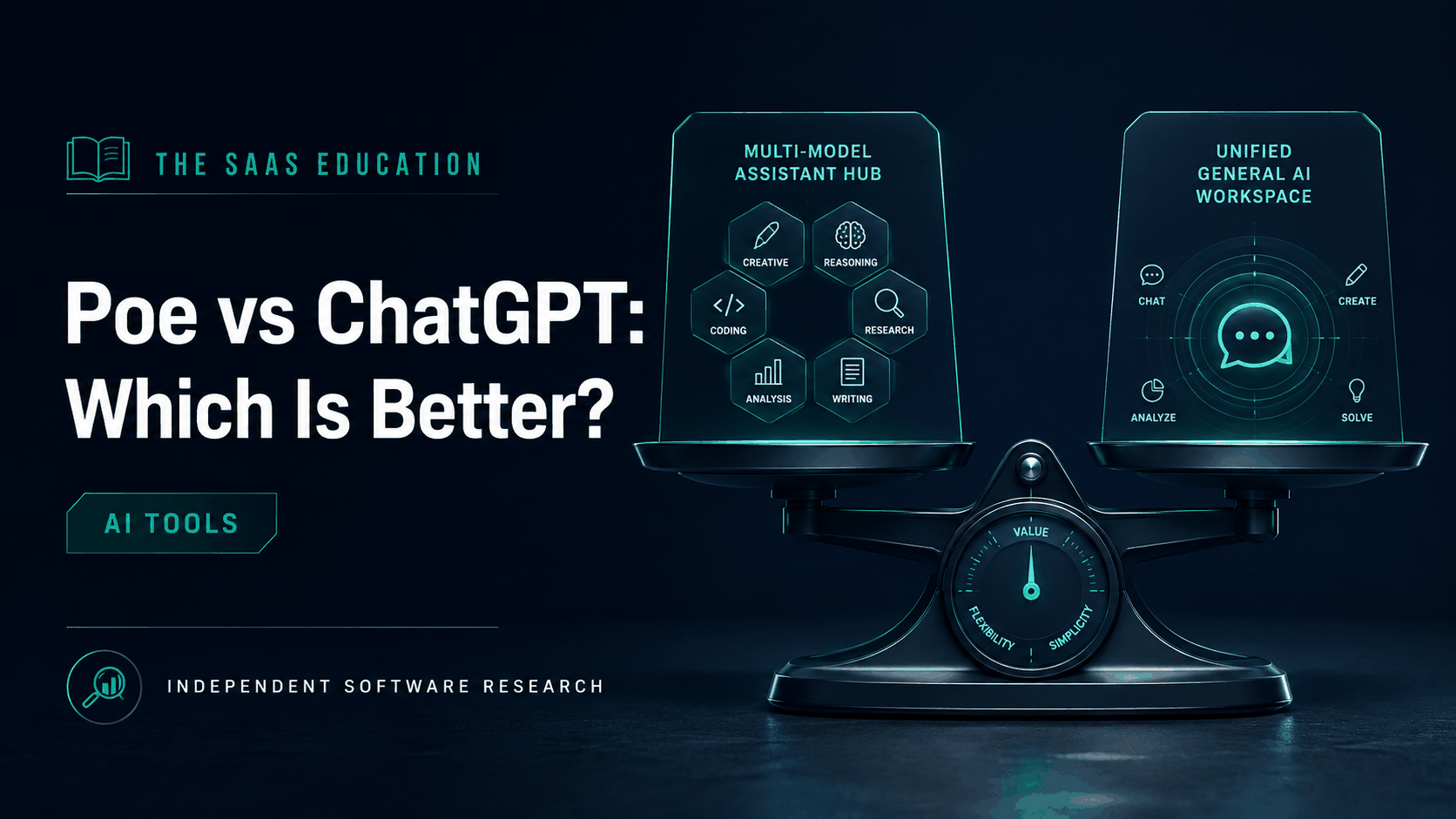
Poe is better for people who want to explore and compare many AI models and specialized bots inside one interface. ChatGPT is better for people who want OpenAI’s cohesive first-party workspace for research, writing, files, analysis, coding, images, voice, projects, and connected work.
Poe is an aggregator and creator platform. ChatGPT is a native product built around OpenAI models and tools. Access to an OpenAI-powered bot on Poe does not reproduce the complete ChatGPT experience, just as access to an Anthropic-powered bot does not reproduce every feature of Claude.
Choose based on the workflow. Poe reduces the friction of trying many models. ChatGPT reduces the friction of staying inside one integrated environment. Neither approach guarantees accurate output, and both require verification for consequential work.
Poe vs ChatGPT at a glance
| Area | Poe | ChatGPT |
|---|---|---|
| Core proposition | Many models and bots in one platform | OpenAI’s general-purpose AI workspace |
| Best for | Model exploration, bot discovery, comparisons, and creator bots | Integrated research, writing, files, data, coding, images, voice, and projects |
| Model choice | Broad provider and bot catalog | OpenAI model selection within current plan |
| Custom experiences | Prompt and API bots | Custom GPTs and plan-dependent workspace tools |
| Usage accounting | Compute points that can vary by bot and request | Plan-dependent messages, tools, and usage limits |
| Product integration | Common Poe interface across many bots | Native integration with OpenAI product features |
| Main risk | Confusing model access with the provider’s native product | Overcommitting to one ecosystem or trusting fluent output |
| Best evaluation | Cost and quality per chosen bot or workflow | Value of the complete native workflow |
What Poe is
Poe describes itself as a place to chat with many AI products, privately or in group chats, and to explore official and user-created bots. Its creator platform also lets developers and builders publish prompt-based or API-connected bots.
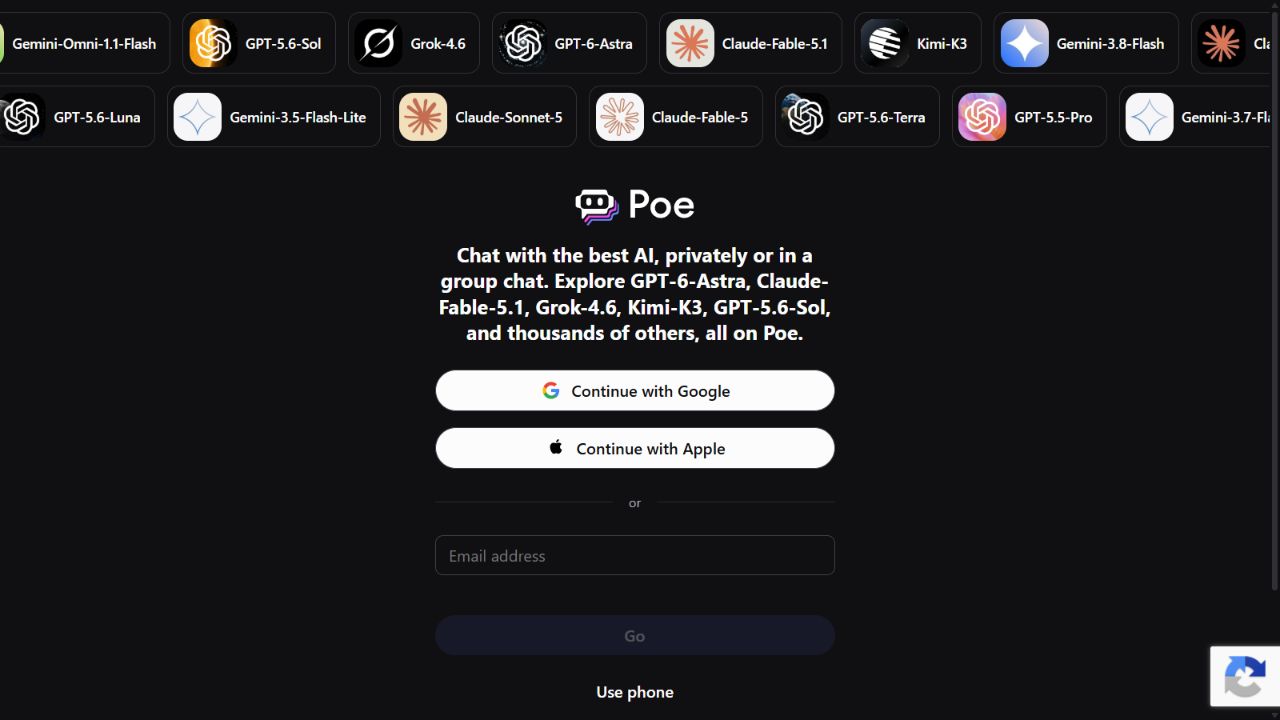
This breadth is the central advantage. A user can try different model families, discover specialist bots, and compare responses without maintaining a direct subscription to every underlying provider. Poe also exposes image, video, audio, and other bot categories as its catalog evolves.
The tradeoff is an additional platform layer. The model, bot configuration, available context, point cost, tools, moderation, provider relationship, and current interface can affect the result. Buyers should identify the exact bot they are evaluating instead of treating “Poe” as one model.
What ChatGPT is
ChatGPT is OpenAI’s first-party AI workspace. Current official pages describe conversational assistance, web search, research, files, data analysis, image creation, voice, projects, Canvas, memory, custom GPTs, and coding-related workflows, with access varying by plan and account.
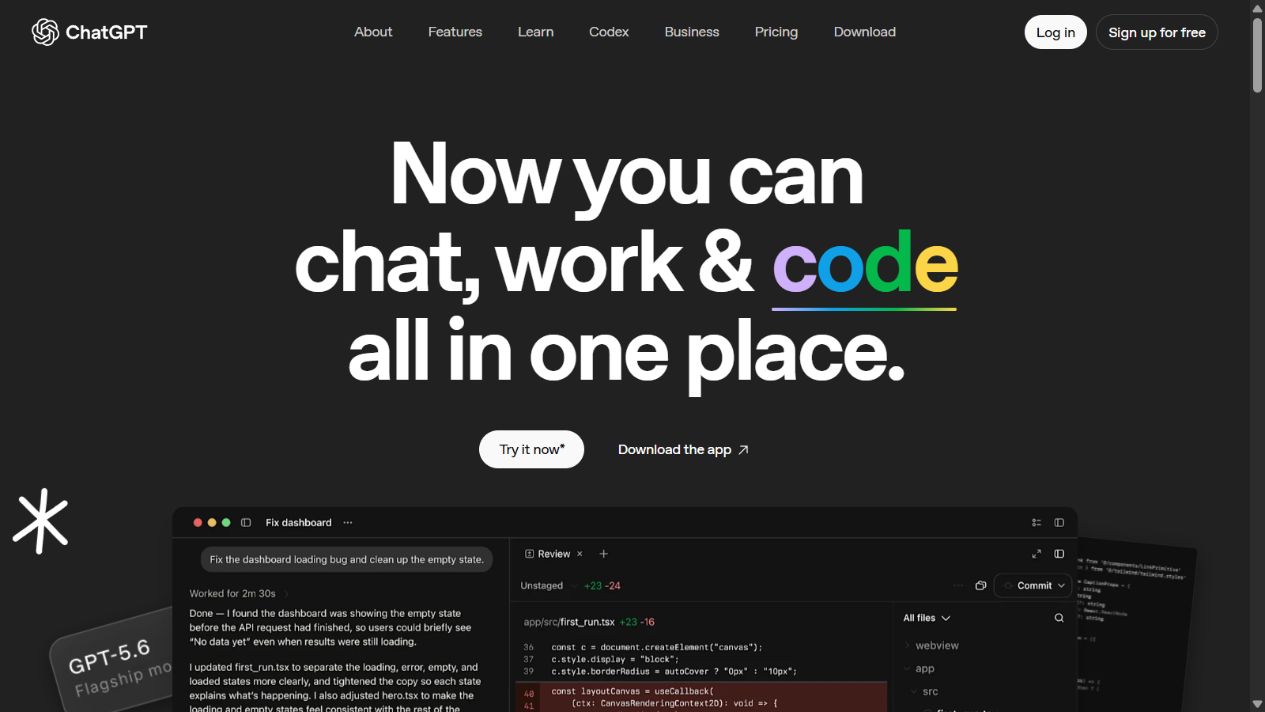
The important difference is product integration. OpenAI controls the models, interface, and native feature roadmap. A task can move from a search or uploaded file into analysis, drafting, editing, images, or project context without switching to a separate provider surface.
That cohesion does not make ChatGPT best at every individual task. It makes the complete workflow easier to understand and govern for users who primarily want OpenAI’s ecosystem.
Model choice and experimentation
Poe wins for breadth. Its official FAQ emphasizes access to a wide variety of AI products and a growing catalog of official and user-created bots. This is useful for people who compare models regularly, need specialist experiences, or do not know which model family suits a task.
Breadth must be managed. Model names, versions, context, point requirements, and availability can change. A popular bot may include a prompt layer that changes behavior. Record the full bot name, provider, date, point cost, settings, and test input when making a repeatable comparison.
ChatGPT offers less cross-provider variety because it is an OpenAI product. That can be an advantage when the goal is consistent access to native OpenAI features rather than ongoing model shopping.
Response quality and accuracy
There is no defensible universal quality winner without a controlled, current, task-specific benchmark. Poe exposes many models, so quality depends on the bot selected. ChatGPT quality depends on the chosen or routed OpenAI model, tools, context, and task.
Use a fixed evaluation set. Include factual research, structured extraction, reasoning, writing, instruction following, and domain-specific tasks. Score source support, correctness, completeness, constraint adherence, consistency, latency, and review time.
Do not use another model’s preference as the judge. Create an answer key where possible and involve a qualified human for domain work. A polished response can still be unsupported.
Poe may help reveal model disagreement quickly. Disagreement is a signal to investigate, not proof that the majority answer is correct. ChatGPT may offer a smoother path from answer to finished artifact, but the artifact still needs review.
Research and web work
ChatGPT provides native web search and plan-dependent research workflows with citations. It can combine discovery with files, analysis, drafting, and project context. This makes it a strong general research workspace.
Poe’s research experience depends on the selected bot and its available capabilities. Some bots may search or retrieve sources; others may rely primarily on model knowledge. Verify the exact bot’s description and inspect the cited pages directly.
For both products, use primary sources, check dates, open citations, and separate evidence from inference. Neither a link nor a confident explanation proves that the linked page supports the claim.
Writing and document work
ChatGPT is generally the safer default for users who want a consistent native environment for outlining, drafting, revision, files, and longer projects. It can preserve workflow context within product boundaries defined by the current plan.
Poe provides more stylistic and model variety. A writer can compare how different bots structure an argument or handle tone. That can improve ideation, but moving among models can also produce inconsistent terminology and duplicated review.
Choose the workflow that reaches an accepted document with the least total effort. Count prompt setup, context transfer, verification, edits, and version management. Generating five alternative drafts is not productive if reviewing them takes longer than writing one controlled draft.
Coding
Both platforms can expose coding-capable models. ChatGPT’s advantage is its native OpenAI coding and workspace integration. Poe’s advantage is the ability to try different model providers and specialist coding bots through one account.
The result should be judged in the development environment. Require tests, linting, type checks, security review, repository conventions, and human understanding. Model access alone does not provide safe code execution, complete repository context, or production accountability.
Poe can be useful for comparing explanations or proposed approaches. ChatGPT can be useful when the OpenAI workflow connects more directly to the user’s working tools. The best product is the one that reliably produces reviewed changes, not the longest code block.
Bots: Poe creators versus custom GPTs
Poe supports prompt bots and API bots. A prompt bot can package instructions around an available model, while an API bot can connect an external model or service through Poe’s documented protocol. This makes Poe attractive to creators who want distribution through a multi-model community.
ChatGPT offers custom GPTs and related first-party configuration. These can combine instructions, knowledge, and current tool capabilities within OpenAI’s product framework.
In either case, a configured bot is not automatically dependable. Test prompt injection, unsupported requests, sensitive-data handling, tool permissions, inaccurate answers, abuse, cost spikes, and failure recovery. Public distribution adds moderation, support, and change-management obligations.
Pricing and usage economics
Poe subscriptions use compute points. The point requirement can be fixed or variable and differs by bot, model, input, and output. Poe’s official subscription page should be checked for the user’s region, taxes, included points, and current terms.
ChatGPT uses subscription tiers with plan-dependent limits and capabilities. API usage is separate from ChatGPT subscriptions. Current prices and allowances should be verified on OpenAI’s official pricing pages.
Sticker prices are not directly comparable. For Poe, calculate points and subscription cost per accepted result across the actual bot mix. For ChatGPT, calculate the total subscription and review cost against accepted time saved across the native workflow.
Heavy use of one expensive Poe bot may consume points differently from light use across several bots. A ChatGPT plan may look simpler but still have workload-specific limits. Run a two-week pilot using real tasks before annual commitment.
Privacy, data, and provider boundaries
Poe’s privacy center distinguishes official bots, prompt bots, and API bots, and explains how interactions may be handled. Its terms also note that third-party model providers or bot developers can be involved in producing responses. Read the current policy for the exact bot and account type.
ChatGPT has its own individual and business data controls, retention choices, and organizational offerings. Do not transfer assumptions from one platform to the other.
For business use, classify data before adoption. Define whether confidential, personal, regulated, client, source-code, or contract material is permitted. Review identity, access, retention, training, connectors, subprocessors, export, deletion, residency, and contract terms applicable to the chosen plan.
Never infer that a well-known underlying model makes every third-party bot suitable for sensitive work. The complete delivery chain matters.
Which should individuals choose?
Choose Poe when:
- you want to compare many model families frequently;
- specialist and community bots are valuable;
- one point-based account is preferable to several direct subscriptions;
- you are willing to track model and bot differences.
Choose ChatGPT when:
- OpenAI’s native tools are the primary requirement;
- files, analysis, research, images, voice, projects, or coding form one workflow;
- consistency matters more than cross-provider breadth;
- you prefer one first-party product relationship.
Start free where available. Upgrade only after a real usage constraint blocks accepted work.
Which should teams choose?
Poe can support model evaluation, experimentation, and creator use. Teams should control which bots are approved, how data is handled, how point use is monitored, and who validates outputs.
ChatGPT can be a stronger general deployment when the organization wants a unified assistant with current workspace administration and OpenAI-native capabilities. The applicable business plan, not an individual subscription, should be evaluated for formal use.
Neither product replaces specialist systems, access control, records management, or accountable review. Avoid organization-wide rollout until a small pilot proves value and governance.
Common decision mistakes
Operational consistency and change management
Poe’s breadth creates a version-control problem that buyers should address explicitly. A workflow can change when a bot switches its underlying model, alters its system prompt, changes point cost, or becomes unavailable. A response that worked last month may not be reproducible unless the team recorded the exact bot and test conditions.
Create an approved-bot register for repeated work. Record the bot URL, displayed provider or model, owner, permitted data class, expected point range, evaluation date, and replacement path. Revalidate it after a material update. This is especially important when a user-created bot influences customer-facing or internal decisions.
ChatGPT has change risk too. Models, routing, limits, and features evolve. Its first-party structure can make the environment more coherent, but it does not freeze behavior. Teams should version important instructions, keep acceptance tests, and avoid depending on undocumented quirks.
For either platform, a useful regression set contains representative prompts and an answer rubric. Run it after major changes. Measure whether outputs remain factually supported, follow constraints, preserve required structure, and stay within acceptable review time. This turns “the tool feels different” into an actionable finding.
Portability and switching cost
Poe can reduce provider lock-in at the model-access layer because several model families are available through one interface. However, workflows can still become tied to Poe-specific bots, point economics, group chats, and creator distribution.
ChatGPT can create switching cost through projects, custom GPTs, saved context, connected tools, and team habits. Those features are valuable precisely because they integrate work, but migration may require rebuilding instructions, knowledge, permissions, and evaluations elsewhere.
Keep durable business knowledge outside either chat product. Store approved source material, final deliverables, prompts, test cases, and governance records in systems the organization controls. Treat the AI workspace as a processing layer, not the only repository of institutional memory.
Before selection, test export and offboarding procedures. Ask what happens when a user leaves, a bot disappears, a provider changes terms, or a plan becomes unaffordable. A slightly less convenient tool with a clear continuity plan may be the better long-term choice.
Support and accountability
When a problem involves an underlying model on Poe, the user may need to distinguish the responsibilities of Poe, the model provider, and a bot creator. Record which service produced the output and consult the applicable support and policy pages.
ChatGPT provides a more direct first-party route for OpenAI product issues, though that does not guarantee a particular resolution or service level. Organizational buyers should evaluate support commitments, incident communication, account recovery, and contractual terms rather than relying on consumer help expectations.
For public bots or automated workflows, assign an internal owner. Someone must monitor failures, costs, complaints, model changes, and policy updates. AI access without operational ownership is experimentation, not a dependable service.
Assuming the same model means the same product
An underlying model accessed through Poe can have different prompts, context, tools, limits, and surrounding features from its provider’s native application.
Counting model quantity as value
A catalog of many models is useful only if users know when to switch and can evaluate results. Otherwise, choice adds cognitive and review cost.
Comparing only monthly price
Include point consumption, unused capacity, review time, context transfer, workflow fragmentation, administration, and expected error cost.
Trusting bot descriptions without verification
Inspect whether a bot is official or user-created, identify its provider where possible, and test it against explicit requirements.
Paying for both without distinct jobs
Two subscriptions make sense when each owns a recurring stage. They do not make sense when users alternate casually between overlapping chat interfaces.
A practical comparison test
- Choose ten recurring tasks and define accepted outputs.
- Select the exact Poe bots and ChatGPT configuration to compare.
- Use identical source material and constraints.
- Record model, bot, date, settings, points, and plan.
- Score correctness, evidence, instruction adherence, consistency, and review time.
- Include privacy and administrative fit.
- Calculate cost per accepted deliverable.
- Repeat enough times to expose variability.
Keep the tool that wins the overall workflow, not merely the most entertaining prompt.
Final verdict
Poe wins for convenient multi-model access, bot discovery, and comparison. ChatGPT wins for a cohesive OpenAI-native workspace and broad production features.
Choose Poe if switching among models is a deliberate part of the job. Choose ChatGPT if one integrated environment is more valuable than provider breadth. Subscribe to both only when measured workflows prove distinct benefits. In every case, verify important outputs and reassess when models, points, plans, or product boundaries change.
Sources
For multi-model evaluation, freeze a task set and scoring rubric before comparing responses. Record the exact bot or model, date, point cost, context supplied, tools used, review time, and accepted result. Repeat the test because model routing and product behavior can change. Do not select a platform from one impressive answer or assume that access to a provider’s model reproduces its native application.
Frequently asked questions
Is Poe better than ChatGPT?
Poe is better for exploring many models and bots through one interface. ChatGPT is better for people who want OpenAI's native, integrated workspace and first-party features.
Does Poe include ChatGPT?
Poe can provide bots powered by OpenAI models, but a bot on Poe is not the same product as the native ChatGPT application, plan, interface, tools, limits, or support relationship.
Which is better for comparing AI models?
Poe is usually more convenient because multi-model access is central to the platform. Use identical prompts and a scoring rubric instead of choosing from one response.
Which is better for business use?
ChatGPT often fits teams that want a cohesive first-party workspace. Poe can fit controlled multi-model evaluation, but organizations must review bot provenance, provider boundaries, data rules, and administration.
Is Poe cheaper than ChatGPT?
A sticker-price comparison is insufficient. Poe uses compute points with model-specific costs, while ChatGPT has plan-dependent limits and features. Compare cost per accepted workflow.
Can I create custom bots on Poe?
Yes. Poe documents prompt bots and API bots through its creator platform. Building a dependable public or internal bot still requires testing, security, moderation, monitoring, and maintenance.
Should I subscribe to both Poe and ChatGPT?
Only if Poe's model breadth and ChatGPT's native workflows create distinct recurring value. A short measured pilot can reveal whether two subscriptions reduce cost or merely duplicate use.