QuillBot vs ChatGPT: Which Is Better?
Compare QuillBot and ChatGPT for paraphrasing, grammar, research, writing, citations, files, originality checks, pricing, and responsible use.

Direct answer
QuillBot is better when the main job is revising existing text through a focused paraphrasing, grammar, summarization, citation, translation, or originality workflow. ChatGPT is better when the job starts earlier and extends further: exploring an idea, researching a question, analyzing files, developing a structure, drafting, revising, coding, or working across multiple media.
The products overlap, but their centers of gravity differ. QuillBot behaves like a collection of writing utilities organized around text transformation and review. ChatGPT behaves like a general-purpose AI workspace that can also edit text. A person who mainly needs sentence-level revision may value QuillBot’s explicit controls. A person who moves between questions, sources, spreadsheets, documents, images, and drafts may obtain more value from ChatGPT.
Neither product should be used to disguise plagiarism, fabricate sources, or submit unreviewed work. A rewritten sentence can preserve grammar while changing meaning. A fluent answer can still be unsupported. The better product is the one that improves an approved workflow while keeping authorship, evidence, and review visible.
QuillBot vs ChatGPT at a glance
| Area | QuillBot | ChatGPT |
|---|---|---|
| Core proposition | Focused writing and text-transformation toolkit | General-purpose AI workspace |
| Best for | Paraphrasing, grammar, summaries, citations, translation, and document utilities | Ideation, research, explanation, drafting, files, analysis, coding, images, and iterative work |
| Starting point | Usually an existing passage or document | A question, goal, file, dataset, image, or draft |
| Rewrite control | Explicit modes and purpose-built interfaces | Natural-language instructions and conversational iteration |
| Research | Citation and document tools, with product-specific limits | Web search and research features, depending on plan and availability |
| Originality tools | AI detection and plagiarism-related tools are listed by QuillBot | No equivalent promise that every account includes a plagiarism checker |
| Integrations | Browser, desktop, and writing-environment extensions or apps | Web, desktop, mobile, projects, connectors, and other plan-dependent tools |
| Main risk | Meaning drift or mechanical rewriting | Unsupported claims, broad scope, and overreliance on fluent output |
What QuillBot is
QuillBot presents a writing and creation workspace with tools for paraphrasing, grammar correction, AI detection, plagiarism checking, humanizing, AI chat, image generation, translation, summarization, citations, PDFs, conversion, and supported applications or extensions. The exact combination, limits, and availability depend on plan and platform.
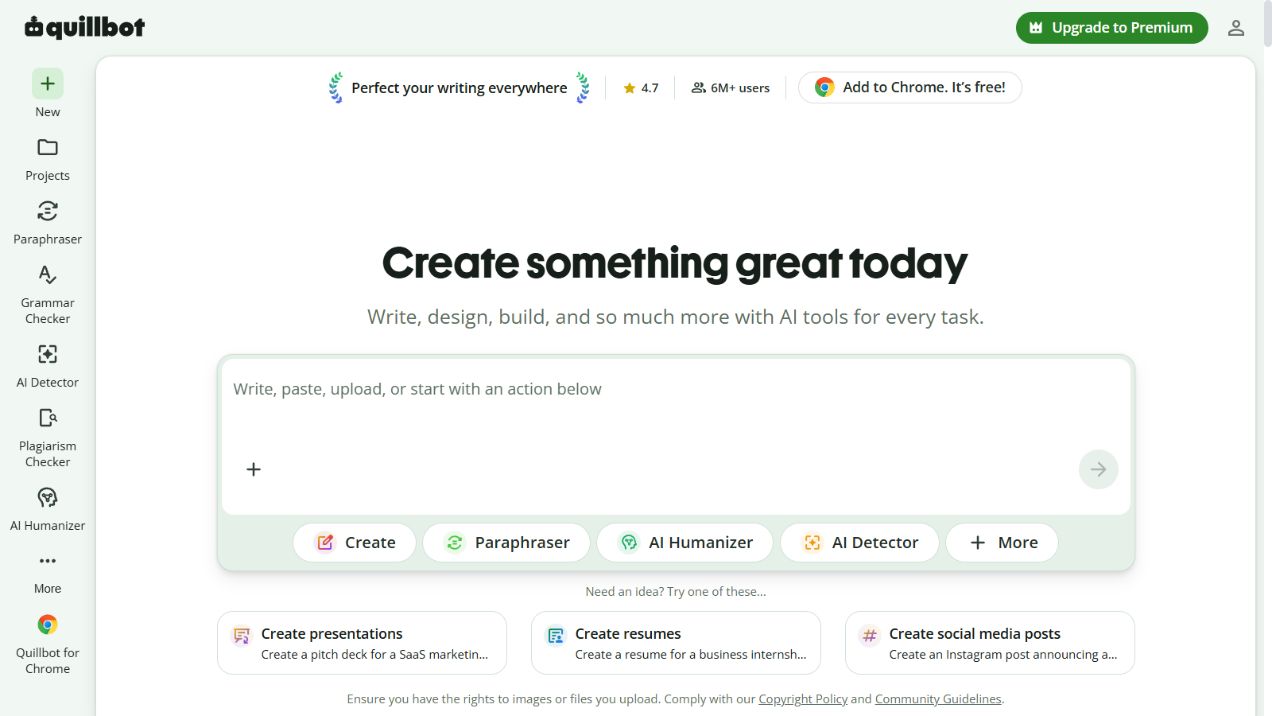
The focused interfaces are important. A user does not have to invent a detailed prompt every time a passage needs shortening, smoothing, formalizing, or restructuring. A named tool, mode, synonym control, or document workflow can make repeated editing more predictable. That is particularly useful for people who already know what the text should say but want help improving expression.
QuillBot should still be treated as an assistant. Paraphrasing can weaken precision, replace a domain term incorrectly, or make an author’s voice less distinctive. Grammar corrections can flatten intentional style. A summary can omit a qualification. Citation formatting can be neat while the source selection remains weak. The original meaning and evidence must stay under human control.
What ChatGPT is
ChatGPT is OpenAI’s first-party AI workspace. Current official product pages describe conversational assistance, web search, research, file analysis, data work, image generation, voice, projects, Canvas, custom GPTs, and coding-related workflows, with access varying by plan, region, and account.
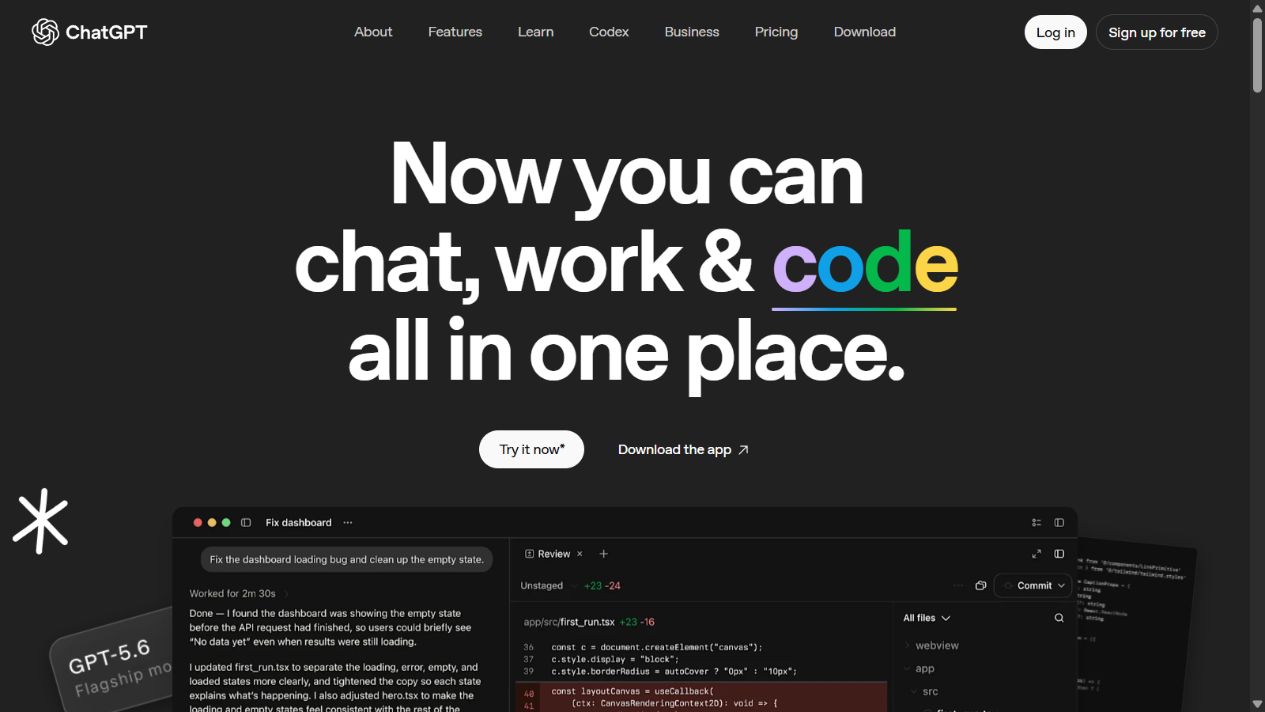
Its advantage is breadth and continuity. A user can ask for an explanation, challenge assumptions, upload source material, compare options, develop an outline, draft sections, revise the tone, and produce a checklist in one conversation or project. Natural-language instructions provide more freedom than selecting a fixed rewriting mode.
That freedom adds responsibility. A broad prompt can produce a broad but shallow answer. Web research can miss evidence. File analysis can misread a table. A confident sentence may be invented. Users need a clear task, supplied context, acceptance criteria, and a review process that fits the stakes.
Paraphrasing and rewriting
QuillBot has the clearer advantage for a narrow paraphrasing task. Its interface is designed around transforming supplied text, and Premium access documents additional modes and limits. This can make the workflow fast: paste a passage, choose a mode, adjust the result, compare alternatives, and retain only edits that preserve the intended claim.
ChatGPT offers a different kind of control. Instead of choosing only a mode, a user can specify audience, reading level, terminology, forbidden changes, required facts, examples, tone, length, and structural constraints. It can explain why a sentence is unclear or offer several approaches. That makes it stronger for developmental editing and complex transformations.
The practical test is not which output sounds more polished. Create representative passages, including technical claims and quotations. Score meaning preservation, factual stability, voice, readability, edit time, and acceptance rate. If the user spends longer repairing a rewrite than editing manually, the apparent speed has no value.
Do not use either tool for synonym substitution intended to conceal copied material. Ethical paraphrasing requires understanding the source, expressing the idea independently, and citing it when attribution is due. Changing the words does not change intellectual ownership.
Grammar, clarity, and style
QuillBot’s grammar and writing tools suit quick correction inside an editing workflow. Dedicated interfaces can reduce friction for spelling, punctuation, sentence construction, and language improvement. Extensions and apps may help users apply those functions where they write, subject to current support.
ChatGPT is more useful when the problem requires diagnosis. A user can ask which passages are ambiguous, where the argument loses continuity, which terms are undefined, or why the tone does not fit an executive audience. It can propose a style guide and then review the draft against that guide.
Neither should make the final decision automatically. Grammar is partly contextual, and style depends on purpose. Product names, legal clauses, scientific terms, quotations, code, dialect, and brand voice can be “corrected” into errors. Use tracked changes or compare versions so an editor can see what moved.
Summaries, research, and citations
QuillBot is convenient when the user has material and wants a summary, citation workflow, or PDF-related utility. This supports study, literature organization, and document processing. The output should be checked against the original, especially where a conclusion depends on methods, population, dates, exceptions, or statistical uncertainty.
ChatGPT has the stronger broad research environment when current web search, research tools, source analysis, and iterative questioning are available. It can help define a research question, identify disagreement, compare sources, build an evidence table, and draft from approved evidence. That does not turn it into a database of record or guarantee complete retrieval.
For academic work, use authoritative databases and read the underlying papers. For commercial research, prioritize primary vendor documentation, contracts, standards, and credible independent evidence. A citation is not proof that a claim accurately represents the source. Open it, inspect the relevant passage, and record the verification date.
Drafting and ideation
ChatGPT is usually stronger when there is no finished source passage yet. It can turn a brief into questions, alternative structures, objections, examples, and a first draft. It can also preserve project context across related tasks, within the limits and behavior of the selected account.
QuillBot’s AI chat and creation tools expand beyond editing, but the product remains especially attractive when creation and revision sit close together. Someone may generate or import a draft, paraphrase selected sentences, correct grammar, shorten a section, and check citations without building a long prompt sequence.
Writers should separate generation from approval. Start with original research or experience. Mark unsupported placeholders. Require evidence for factual claims. Preserve interviews and quotations exactly. Then use AI for bounded assistance, not for manufacturing authority the author has not earned.
AI detection and plagiarism checks
QuillBot lists AI detection and plagiarism-related capabilities. These address common buyer questions, but the two concepts must not be confused. Plagiarism concerns unattributed use of another person’s work. AI detection attempts to infer how text may have been produced. One is an evidence and attribution question; the other is a probabilistic classification problem.
An AI detector should not be treated as definitive proof. Human writing can be flagged, AI-assisted writing can pass, and editing changes scores. Schools and employers should investigate source history, drafts, citations, process evidence, and applicable policy. High-impact decisions need a fair appeal path.
ChatGPT can discuss originality or compare passages supplied to it, but users should not assume the product includes a comprehensive plagiarism database or authorship detector. Verify the actual feature and coverage rather than inferring it from general AI capability.
Files, data, coding, images, and voice
ChatGPT has a decisive breadth advantage for workflows extending beyond prose. Depending on the plan, it can analyze uploaded files, work with data, explain code, help create images, use voice, maintain projects, and connect to other information sources. A single subscription may therefore replace several isolated experiments for a multidisciplinary user.
QuillBot now presents creation, image, PDF, and conversion tools alongside writing utilities, so it should not be reduced to one paraphraser. Even so, buyers should test the exact jobs they perform. A long feature list does not establish depth, integration, output quality, or governance.
For code, numbers, contracts, health information, and other consequential material, require domain review. Run tests, recalculate values, compare clauses, and follow professional standards. The more media types a tool supports, the more varied its failure modes become.
Pricing and value
QuillBot documents Free and Premium access. Its help center states that Premium may be purchased through monthly, quarterly, or annual options and that price can adjust by region and currency. Current checkout details should be verified before purchase. Platform-specific plans or limits may also differ.
ChatGPT offers free and paid plans, with product features, usage, administration, and business terms varying by plan. A ChatGPT subscription does not automatically include API usage; buyers should separate consumer or workspace subscriptions from metered API services.
Do not compare only monthly labels. Measure cost per accepted task. Include subscription, taxes, unused seats, review time, corrections, training, administration, duplicate tools, and switching. A cheaper specialist can deliver better value for high-volume rewriting. A more expensive general tool can deliver better value if it replaces several recurring workflows.
Run a two-week pilot with a fixed task set. Record time before assistance, time using the tool, human review time, acceptance, errors, and downstream impact. Purchase only when the net improvement repeats.
Privacy and responsible use
Before entering confidential information, review the current account terms, privacy documentation, training controls, retention, sharing, integrations, and administrative settings. Consumer access and business offerings may have different commitments. An employee’s personal subscription is not a substitute for company approval.
Classify data into allowed, restricted, and prohibited groups. Remove unnecessary personal or client details. Use organization-managed accounts where available. Define who approves public, customer-facing, legal, financial, academic, or regulated output. Retain enough evidence to reproduce important decisions.
For education, follow course and institution rules. Disclose assistance where required. For publishing, preserve human authorship and source accountability. For business communication, do not let fluent rewriting change commitments, warranties, dates, or obligations.
Which should you choose?
Choose QuillBot when your recurring work begins with existing text and you want direct controls for paraphrasing, grammar, summaries, translation, citations, and related document utilities. It is the more focused choice for a writer who values a repeatable editing interface.
Choose ChatGPT when your work crosses ideation, research, explanation, files, analysis, drafting, coding, images, voice, and project context. It is the broader choice for users who want one conversational workspace and are prepared to define and verify each task.
Choose both only when measured usage supports two distinct roles. For example, ChatGPT may help research and structure a draft while QuillBot supports controlled sentence-level revision. Avoid paying for overlap based on feature lists alone.
Choose neither paid plan when occasional free access handles the work, policy prevents the intended use, or review effort eliminates the savings.
Practical workflow tests
A fair comparison needs more than one polished paragraph. Build a small test pack from work you actually perform and remove confidential data. Include a rough email, a technically precise paragraph, a long report section, a passage written by a non-native English speaker, a source-based summary, and a draft with deliberate factual and grammatical errors. Keep an untouched reference version.
For the paraphrasing test, require each product to preserve names, dates, measurements, qualifications, and citations. Ask for a concise version, a plain-language version, and a version for a defined professional audience. Review whether the product silently strengthens a claim, removes uncertainty, changes causation into correlation, or replaces necessary terminology. QuillBot’s modes may make variants quicker to request; ChatGPT’s instructions may make constraints easier to express. The accepted result matters more than the number of variants.
For the editing test, separate correction from rewriting. First ask for errors only. Then ask for clarity improvements with explanations. Finally ask for a polished version. This reveals whether the tool can preserve voice and whether the user can see why a change was suggested. Automatic acceptance is a poor workflow for contracts, scientific statements, policy, customer commitments, or brand-sensitive language.
For research and summary, provide a source whose conclusion contains important caveats. Check whether those caveats remain. Then ask each product to identify what cannot be concluded. A useful assistant should help expose uncertainty instead of merely producing a confident abstract.
Score each task from one to five for factual preservation, readability, control, traceability, speed, and review burden. Record severe errors separately; an average score can hide one dangerous change. Repeat the test with the intended users because prompt skill, language confidence, and accessibility affect outcomes.
Team implementation considerations
A team should standardize the workflow before buying seats. Define approved tasks, prohibited data, source requirements, review owners, and where final documents are stored. Create examples of acceptable prompts or mode settings, but allow users to explain when a template does not fit.
Decide whether the organization needs centralized billing, identity controls, activity visibility, shared resources, or support. Do not assume an individual Premium subscription provides the same governance as a business offering. Review current terms for each proposed account type.
Introduce one use case at a time. A communications team might begin with plain-language revisions; a support team might test response consistency; a research team might test source-based summaries. Audit accepted outputs and corrections for several weeks. Expand only when quality remains stable and users understand the limits.
Maintain a fallback. Staff should be able to complete critical writing when the service is unavailable, a feature changes, or a limit is reached. Preserve original drafts and source material so an AI transformation never becomes the only record of an important statement.
Evaluation checklist
Test both tools with the same approved material and score:
- preservation of meaning, terminology, numbers, and citations;
- grammar, readability, tone, and voice;
- quality of summaries and source traceability;
- control over length, structure, and required facts;
- file, PDF, research, data, or multimedia needs;
- browser, desktop, mobile, extension, and collaboration fit;
- plan limits, regional pricing, and total cost;
- privacy, retention, training, sharing, and administration;
- accessibility and ease for the intended users;
- review time, corrections, and accepted-output rate.
Reject a workflow that makes errors harder to see. The winning product should make human judgment easier, not merely produce more text.
Final verdict
QuillBot and ChatGPT are substitutes only at the surface level. QuillBot is a specialized writing toolkit whose value is speed and explicit control over common text tasks. ChatGPT is a broad AI workspace whose value is flexibility and continuity across many kinds of work.
For paraphrasing and routine language revision, start with QuillBot. For research-led creation and mixed workflows, start with ChatGPT. In either case, use original evidence, retain authorship, review every material change, and judge value by accepted work rather than output volume.
Sources checked
Frequently asked questions
Is QuillBot better than ChatGPT?
QuillBot is better for a focused rewriting and language-editing workflow. ChatGPT is better for broad ideation, research, analysis, drafting, files, coding, and multimodal work.
Can ChatGPT replace QuillBot?
ChatGPT can rewrite and edit text, but it does not reproduce every QuillBot mode, extension, citation, originality, and document utility. Replacement depends on the exact workflow.
Which is better for paraphrasing?
QuillBot provides a purpose-built paraphraser with explicit modes and controls. ChatGPT offers more flexible instruction-based rewriting. Both can alter meaning, so compare the result with the source.
Which is better for students?
QuillBot can be convenient for correction, summaries, citations, and revision. ChatGPT can support explanation and study planning. Students must follow institutional rules and never disguise copied work.
Is QuillBot's AI detector reliable?
AI detection is probabilistic and should not be treated as proof of authorship or misconduct. Use it as a limited signal and require evidence-based human review.
Which is cheaper, QuillBot or ChatGPT?
Prices and regional billing vary. Compare the current checkout price with the number of accepted tasks, time saved, review effort, and whether either subscription duplicates tools already available.
Can businesses use QuillBot or ChatGPT for confidential writing?
Only under an approved data policy and suitable account terms. Review retention, training, access, integrations, sensitive-data restrictions, and human approval before using either product.