Replit Agent vs ChatGPT: Which Is Better?
Compare Replit Agent and ChatGPT for planning, building, testing, debugging, deploying, maintaining, and governing software projects.
Direct answer
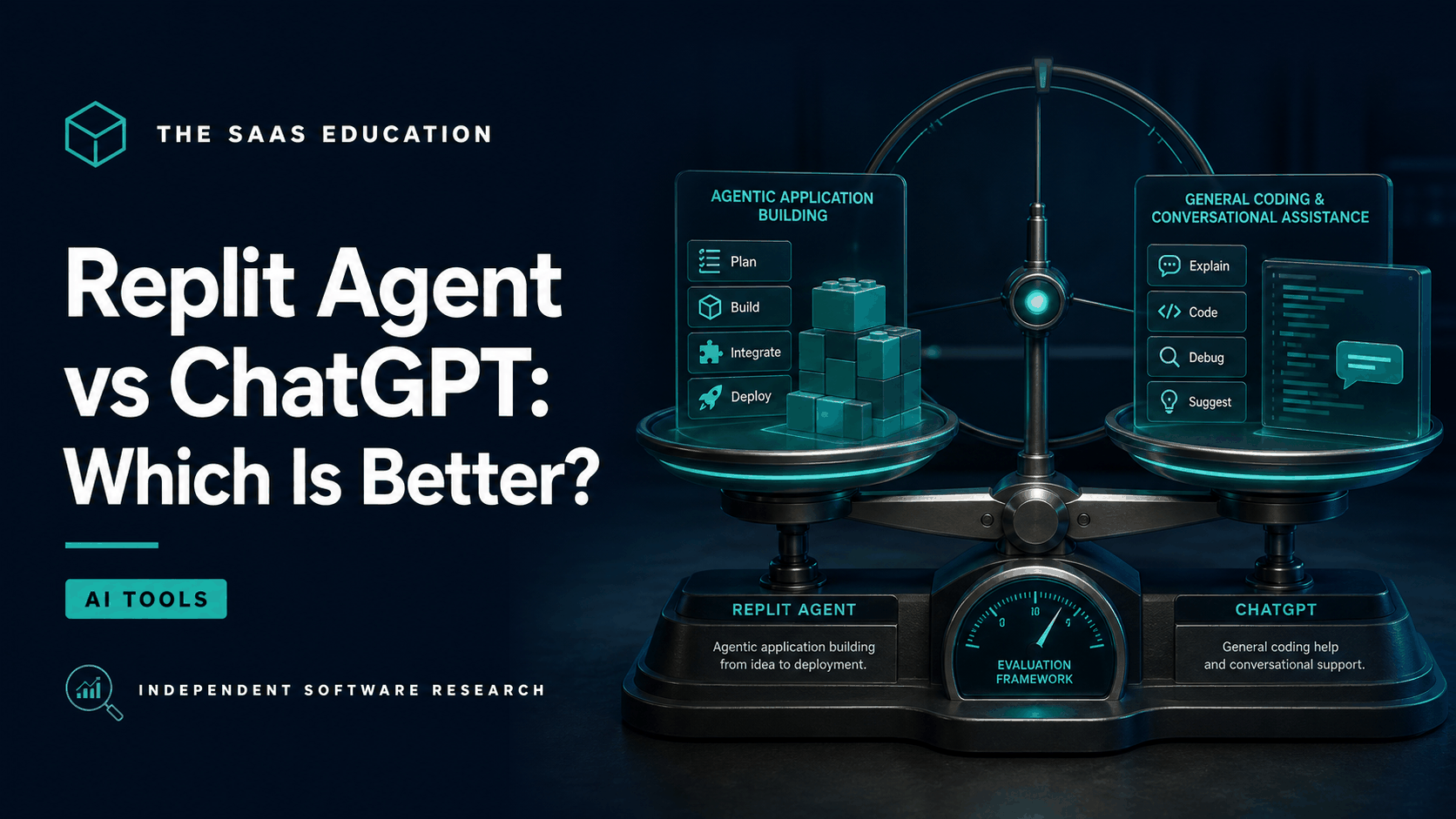
Replit Agent is better when the goal is to turn an application idea into a running, editable, and publishable Replit project inside one browser-based environment. ChatGPT is better when the goal is broader: clarify requirements, research options, explain architecture, review code, analyze files, debug across environments, or support software work that does not live primarily in Replit.
The comparison is not simply “which model writes better code?” Replit Agent is part of a development platform with an editor, runtime, database, checkpoints, collaboration, and publishing. ChatGPT is a general AI workspace with coding capabilities and plan-dependent tools. The environment around the model often determines which product completes the workflow with less friction.
Replit also provides an official integration that lets ChatGPT create and modify Replit Apps. That means the products can complement each other. The final choice should depend on repository ownership, deployment needs, team skills, cost controls, security requirements, and the ability to maintain the app after the first successful generation.
Replit Agent vs ChatGPT at a glance
| Area | Replit Agent | ChatGPT |
|---|---|---|
| Core proposition | Integrated AI application builder inside Replit | General-purpose AI workspace with coding assistance |
| Best for | Going from prompt to hosted Replit app | Planning, explanation, analysis, review, code generation, and mixed workflows |
| Development environment | Browser editor, runtime, database, history, and publishing | Conversation, files, projects, Canvas, and coding tools depending on plan |
| Deployment | Native Replit publishing options | Deployment depends on the chosen external platform or connected workflow |
| Recovery | Replit documents checkpoints and rollback | Version recovery depends on files, repository, tool, and workflow |
| Cost model | Plan plus credits, effort-based Agent use, and cloud services | Plan subscription; API, infrastructure, and external services are separate |
| Main advantage | One integrated path to a working application | Breadth, reasoning context, explanation, and portability across tasks |
| Main risk | Rapidly generated apps can hide security, data, cost, and maintenance issues | Generated code may be detached from the real runtime and deployment context |
What Replit Agent is
Replit Agent is Replit’s AI software builder. Its official product page says users can describe an app or website idea and refine the result through conversation. Documentation explains that Agent can plan changes, write code, explain behavior, debug, improve an app, and work with Replit’s surrounding development and cloud platform.
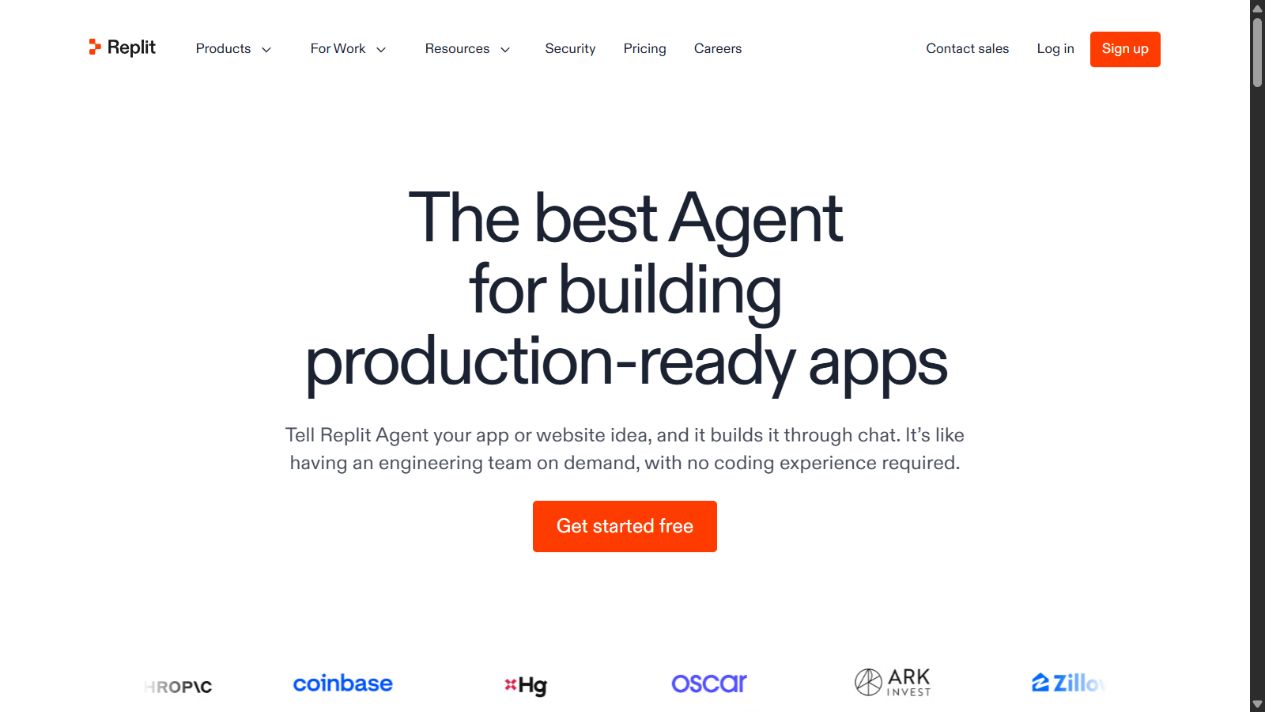
Replit’s environment is the differentiator. The app can be created where it will run. The user can inspect files, preview behavior, connect a database, manage secrets, use checkpoints, collaborate, and publish without manually assembling a local editor, runtime, repository host, and deployment provider.
Current plan documentation distinguishes capabilities such as Lite and Full build, Plan Mode, Design Canvas, visual editing, connectors, task planning, background tasks, collaboration, and publishing. Exact access depends on plan and can change.
What ChatGPT is
ChatGPT is OpenAI’s general-purpose AI workspace. Official pages describe writing, research, web search, file analysis, data work, images, voice, projects, Canvas, custom GPTs, and coding-related workflows, with access varying by plan and account.
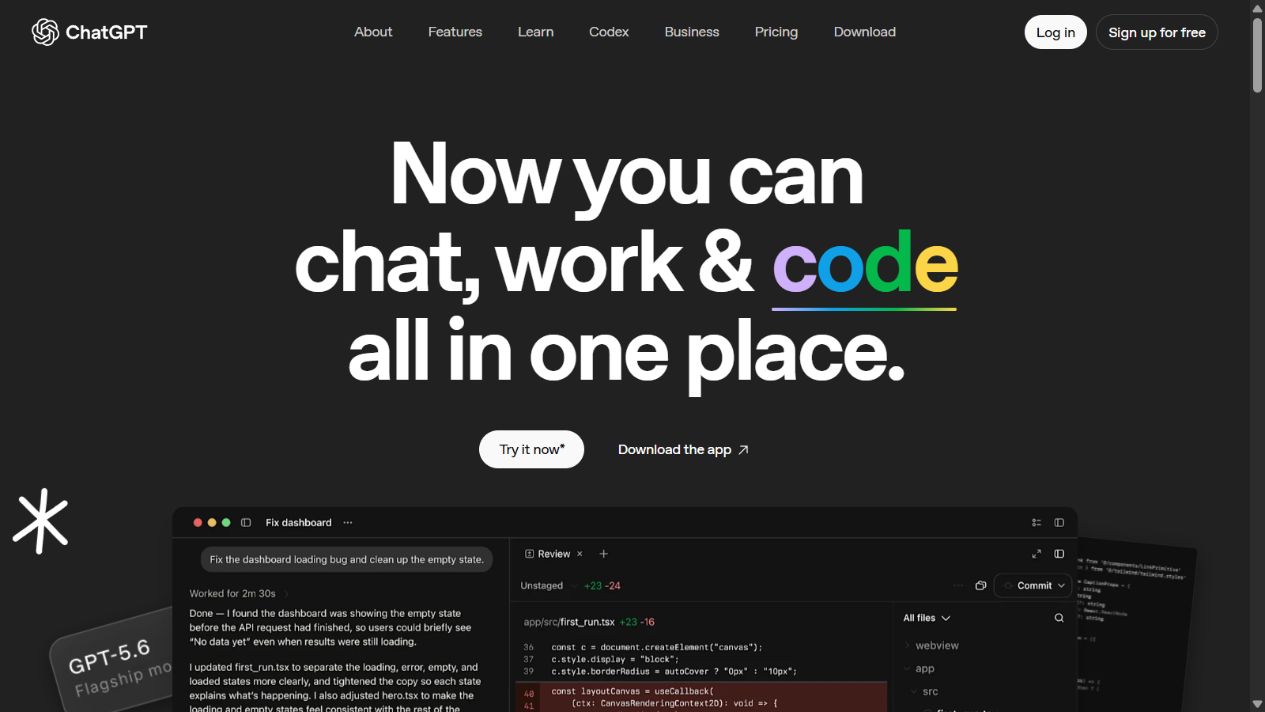
ChatGPT’s strength is not one deployment target. It can help a founder turn a business idea into requirements, challenge assumptions, compare architecture, explain unfamiliar code, draft tests, inspect logs, analyze a security concern, prepare documentation, and work with material beyond the application itself.
That flexibility can create more handoffs. Unless a connected coding environment is in use, generated code must be transferred to the real repository, run, tested, reviewed, and deployed elsewhere. Context can be incomplete, and a snippet that looks correct may fail in the actual stack.
Idea to prototype
Replit Agent has the clearer advantage for a user who wants to see a working prototype quickly. A prompt can lead directly to project files and a running preview. The user can give visual or functional feedback and continue inside the same environment. This shortens the distance between description and observable behavior.
ChatGPT can produce a stronger discovery conversation before implementation. It can ask who the users are, what action matters, what data is required, what must not happen, and how success will be measured. It can produce a concise specification that reduces uncontrolled scope.
The best workflow may combine these strengths: develop the brief and acceptance criteria, then give Replit Agent a bounded build. Fast generation without a stable brief often produces a polished interface around unclear behavior.
Full-stack development
Replit Agent is designed to create applications rather than isolated snippets. The integrated environment can coordinate frontend, backend, data, runtime, and publishing. Replit’s pricing material describes built-in databases and plan-dependent app publishing, while its docs explain AI integrations and broader platform services.
ChatGPT can reason across a full stack, but its effectiveness depends on context and tool access. If it cannot inspect the complete repository, run the application, observe errors, and execute tests, it may solve the wrong version of the problem. In an agentic coding environment, the distinction narrows; in ordinary chat, it remains material.
Neither product guarantees production architecture. Generated applications can mix concerns, omit validation, expose privileged actions, or choose dependencies without considering long-term support. Require a developer to inspect boundaries, data flow, authentication, authorization, secrets, migrations, failure modes, and observability.
Planning and requirements
Replit documents Plan Mode and recommends being specific, planning work, adding context, reviewing and testing, and using checkpoints. These are sound practices. A plan should identify the user, goal, non-goals, inputs, outputs, data model, permissions, acceptance tests, and deployment constraints before large changes begin.
ChatGPT is especially useful for this reasoning stage because the conversation can include market notes, screenshots, documents, policy, and alternative technical choices. Ask it to surface ambiguities and risks rather than immediately generate code.
For both tools, approve the plan before execution. Break a large build into observable slices. A sign-in flow, role model, payment event, file upload, or data deletion path deserves explicit acceptance criteria. “Build the app” is not a testable instruction.
Testing and debugging
Replit Agent can observe the application in its native environment and modify code in response to errors. Replit documentation encourages review and tests and explains checkpoints for recovery. This feedback loop is valuable because debugging requires runtime evidence.
ChatGPT can help interpret stack traces, explain likely causes, propose tests, and compare fixes. It is useful as a second reviewer when the builder is stuck or when a failure crosses layers. But pasted logs may omit environment details, and generated fixes should be executed rather than accepted on explanation alone.
Create automated tests for critical paths. Test happy paths, invalid input, permissions, concurrent actions, network failure, rate limits, data loss, and rollback. Run dependency and secret scans. Inspect browser accessibility and performance. For payments, identity, health, legal, or financial data, involve experienced reviewers.
Deployment and operations
Replit’s strongest product-level advantage is the integrated path to publishing. Plans document different allowances and controls for apps, regions, private deployment, databases, and collaboration. A prototype can become a shareable application without moving platforms.
Publishing is not the same as operating reliably. Buyers must understand domain configuration, certificates, environments, backups, database recovery, scaling, logs, alerts, incident response, spending limits, data location, and vendor exit. Test restoring data and rolling back a broken release before inviting real users.
ChatGPT does not inherently replace a hosting platform. It can help configure one, but the organization remains responsible for cloud accounts, credentials, pipelines, infrastructure, monitoring, and cost. This separation can be an advantage when the team already has a standard production platform.
Checkpoints, version control, and ownership
Replit’s checkpoints help users recover when Agent changes make an app worse. Official guidance describes reviewing checkpoint history and rolling back files, Agent memory, tasks, and optionally database state. That is useful protection for exploratory building.
Checkpoints should not be confused with a complete engineering governance strategy. Confirm source-control behavior, branching, review, commit history, external repository synchronization, database migration rollback, and backup. The business needs durable ownership independent of one conversation or user account.
With ChatGPT, version control depends on the connected environment. In ordinary chat, users should never overwrite a working project with an unreviewed generated block. Use a branch, inspect the diff, run tests, and preserve a rollback point.
Collaboration
Replit plans publish different collaborator and parallel-agent allowances. Integrated collaboration can help a small team review the same running app and avoid exchanging zip files. Enterprise paths add organizational controls that should be verified in the proposal.
ChatGPT offers individual and business workspace options, but collaboration around a conversation is not the same as collaborative source control and deployment. Teams need to decide where requirements, code, decisions, tests, and incidents live.
Avoid shared credentials. Require named users, least privilege, protected secrets, and clear ownership. A contractor’s departure should not remove the only access to code, database, domain, or deployment.
Pricing and total cost
Replit’s current pricing page lists Starter, Core, Pro, and Enterprise paths. It combines plan features with monthly credits, Agent use, publishing, databases, storage, and other cloud services. Replit documents effort-based pricing for Agent and provides spending controls. Current prices and allowances should be checked at purchase.
ChatGPT has free and paid plans. API use, hosting, databases, domains, monitoring, and other application infrastructure are separate. A ChatGPT subscription should not be treated as an all-inclusive application-development budget.
Compare total cost per maintained application. Include generation, retries, cloud usage, database, storage, outbound traffic, integrations, domains, developer review, security, testing, incident work, migration, and exit. A cheap prototype that cannot be safely maintained is expensive.
Security and privacy
AI-generated code needs the same or stronger review as human code because the user may not understand every dependency or path. Check input validation, output encoding, authentication, authorization, session handling, cross-site protections, API access, secrets, logging, encryption, retention, deletion, and administrative actions.
Review each vendor’s current privacy and security terms for the selected plan. Do not place production secrets, customer data, proprietary code, or regulated information in an unapproved account. Separate development and production, and restrict database access.
Use threat modeling before launch. Ask what an unauthenticated visitor can do, what one customer can see about another, what happens if an integration is compromised, and how misuse is detected. Run independent security testing for material applications.
Which should you choose?
Choose Replit Agent when speed from idea to running application matters, Replit is an acceptable development and hosting environment, and the team wants integrated building, preview, database, checkpoints, collaboration, and publishing.
Choose ChatGPT when the work is broader than one app platform, the repository lives elsewhere, or the primary need is requirements, explanation, research, architecture, review, and debugging support across a varied stack.
Use both when each has a defined role. ChatGPT can help refine requirements and review decisions, while Replit Agent performs changes in the running project. Replit’s official ChatGPT integration can connect these experiences, subject to current plan, billing, and project limitations.
Choose neither as an autonomous developer. Every production app needs accountable ownership, tests, security review, operations, and a maintenance path.
Practical evaluation
Test maintainability, not only creation
The first build rewards generation speed. The second month reveals whether the app is maintainable. After the prototype passes, give it to a different person with only the repository, requirements, and operating notes. Ask that person to add a field, change a permission, investigate an error, update a dependency, and deploy safely. Record how much of the system they can understand without replaying the original conversation.
Inspect code organization and naming. Identify where validation, business rules, authorization, database access, and external services live. Search for duplicated logic, hard-coded secrets, silent exception handling, dead code, and generated dependencies that do not serve a clear purpose. A working preview can conceal a structure that makes every future change risky.
For Replit Agent, verify that checkpoints, project history, source control, environment configuration, database state, and deployment history provide enough recovery. For ChatGPT-assisted work outside Replit, verify branches, commits, pull requests, CI, infrastructure configuration, and backups. Neither conversation history nor a visual preview should be the only explanation of the system.
Test a production incident
Simulate a failed deployment, unavailable external API, invalid database migration, unexpected traffic increase, and compromised credential. Confirm that the team can detect the problem, identify the affected version, stop further damage, restore service, rotate secrets, recover data, and communicate status. Agent assistance can suggest actions, but an accountable operator must approve and verify them.
Review logs for personal or sensitive data. Ensure errors do not expose secrets or internal stack details to users. Add alerts for failures that matter, not every noisy event. Document who receives the alert and what they should do when the AI service itself is unavailable.
Test portability and exit
Before committing to a platform, export or synchronize the complete application to a location the organization controls. Inventory source code, dependencies, database schema and data, uploaded files, secrets, domains, scheduled jobs, environment variables, analytics, and deployment configuration. Rebuild the project from documented instructions in a clean environment.
Replit’s integrated experience can reduce setup work, but the team should understand which services are portable and which depend on Replit. ChatGPT may appear more portable because it is not the host, yet its generated workflow can still depend on proprietary tools or undocumented prompts. Choose dependencies deliberately and maintain an exit plan proportional to the application’s importance.
Compare user roles
A nontechnical founder may value Replit Agent’s ability to produce an observable app and accept visual feedback. A professional developer may prefer ChatGPT inside an existing repository and toolchain. A product manager may use ChatGPT for discovery while asking engineers to implement. A small internal-tools team may prefer Replit for speed if security and data requirements permit it.
Do not force one score across these roles. Evaluate task completion, comprehension, control, and risk for the actual operator. The best tool is one the responsible team can understand and govern after the exciting first build.
Build the same small but realistic application in a controlled environment. Include authentication, two roles, validated input, a database relationship, one third-party API, an audit event, a failed request, and deployment. Provide identical acceptance criteria.
Record planning time, generations, credit or plan consumption, code changes, manual corrections, failed attempts, test coverage, security findings, deployment time, and the ability of another person to maintain the result. Repeat one change after a week to test continuity.
Score the completed system, not the demo. A beautiful first screen should not outweigh weak permissions, lost data, inaccessible controls, or an unknown bill.
Final verdict
Replit Agent is the better application-building product when its integrated platform matches the target. ChatGPT is the better general AI collaborator for software work that spans discovery, explanation, analysis, code, and external environments.
For a beginner or founder, Replit Agent offers the shorter route to a working app. For an engineering team with an established repository and infrastructure, ChatGPT may fit as one assistant among existing tools. In both cases, human review and operational ownership determine whether generated software becomes a dependable product.
Sources checked
Frequently asked questions
Is Replit Agent better than ChatGPT for coding?
Replit Agent is better for building and publishing an app inside one integrated Replit environment. ChatGPT is better for broader explanation, research, code review, and workflows spanning other tools or repositories.
Can Replit Agent build a complete app?
Replit says Agent can create production-ready apps from natural-language instructions. Users still need to verify requirements, code, security, data behavior, tests, reliability, and deployment.
Can ChatGPT build a Replit app?
Replit provides an official ChatGPT integration that can create, update, and inspect Replit Apps. Work is billed as Replit Agent usage and current integration limitations apply.
Which is better for beginners?
Replit Agent offers the shorter integrated path from idea to running app. ChatGPT can be stronger for learning concepts and comparing approaches. Beginners need extra safeguards because they may not recognize unsafe code.
Which is cheaper?
The cost models differ. Replit combines subscriptions, credits, Agent usage, hosting, databases, and other cloud services. ChatGPT has plan-based access, while API and hosting costs are separate. Compare total cost per maintained app.
Do developers still need to review AI-generated code?
Yes. Review dependencies, secrets, authentication, authorization, data access, tests, error handling, accessibility, performance, licensing, deployment, monitoring, and rollback before production use.
Should a business use Replit Agent or ChatGPT?
Use Replit Agent when an integrated build-and-host workflow fits the application. Use ChatGPT when the organization needs broader analysis or works in another engineering stack. Governance and ownership matter more than the demo speed.