Runway vs ChatGPT: Which Is Better?
Compare Runway and ChatGPT for AI video, image creation, editing, story development, research, workflows, pricing, rights, and team production.
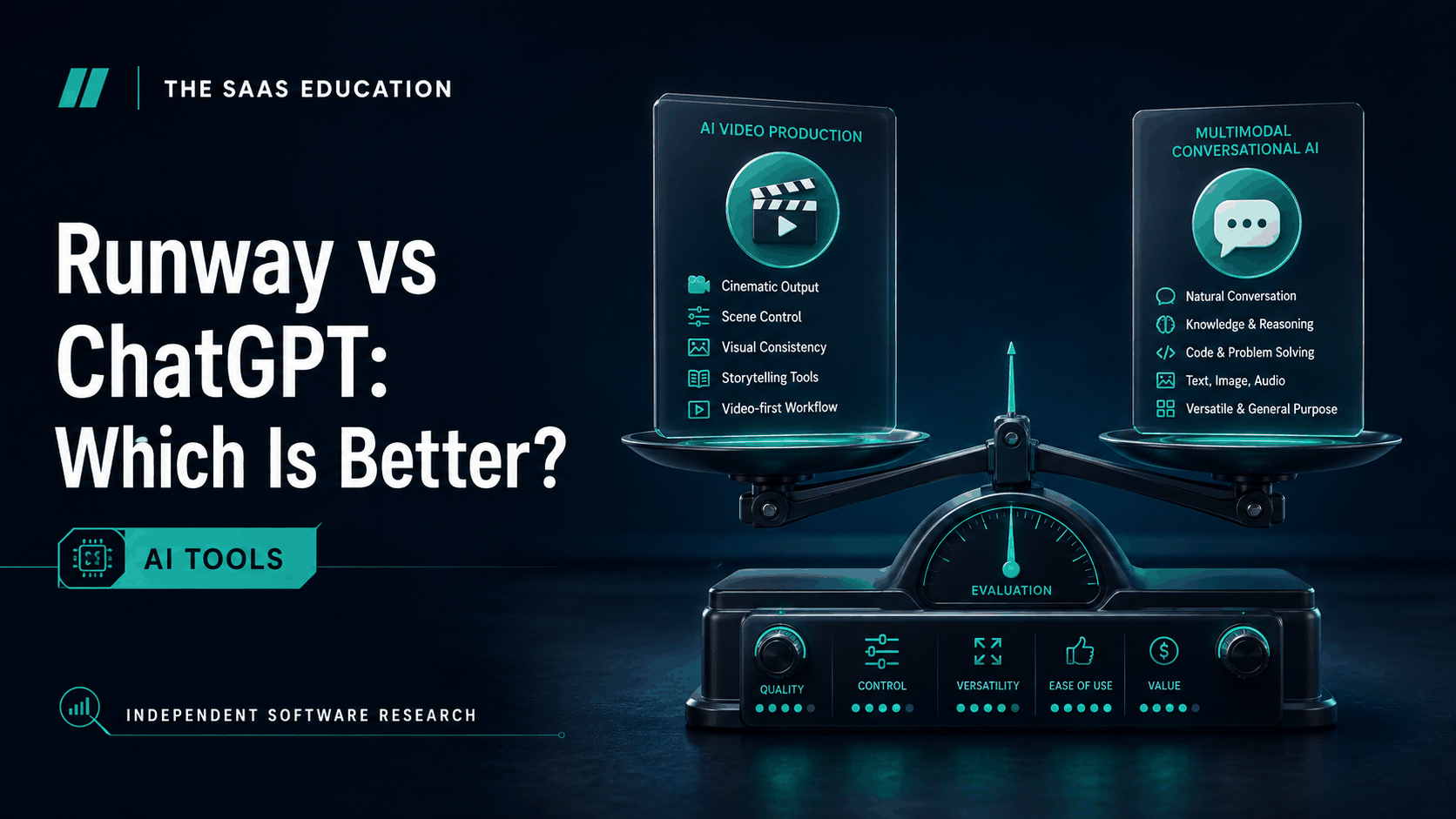
Direct answer
Runway is better when the primary deliverable is generated or transformed visual media, especially video. ChatGPT is better when the work spans research, ideas, writing, analysis, files, coding, images, and general problem solving. Runway is a specialized creative-production environment; ChatGPT is a broad AI workspace.
For filmmakers, creative studios, educators, and marketing teams, Runway offers deeper control over video generation, image-to-video, visual editing, performance capture, timelines, and repeatable media workflows. ChatGPT is more useful for developing the brief, researching the audience, writing scripts, comparing concepts, analyzing feedback, and coordinating work beyond the media asset.
The two products can be complementary. A team may use ChatGPT to turn a campaign goal into a script and shot plan, then use Runway to generate, transform, assemble, and iterate on footage. The workflow succeeds only when humans review continuity, rights, brand accuracy, factual claims, accessibility, and production quality.
Runway vs ChatGPT at a glance
| Area | Runway | ChatGPT |
|---|---|---|
| Core proposition | Specialized generative media and creative production | General-purpose AI workspace |
| Best for | Video generation, visual transformation, performance, editing, and production workflows | Research, ideation, writing, analysis, files, coding, images, voice, and projects |
| Video workflow | Models, tools, apps, agent, sessions, timeline, and workflows | Availability and depth depend on current plan and product features |
| Image workflow | Generation, references, editing, and visual inputs | Image creation and analysis within broader conversations |
| Planning | Creative agent and production-oriented tools | Broad strategy, script, research, and critique |
| Pricing | Plan and credits, with cost affected by model and generation | Plan-based access; other services may be separate |
| Main advantage | Specialist control from shot creation through editing | Breadth and continuity across non-video work |
| Main risk | Credit-consuming iteration and inconsistent visual output | General capability may not provide specialist production controls |
What Runway is
Runway is a generative media and creative-production platform. Its official material covers video and image generation, visual editing, performance capture, audio, voiceover, creative agents, task-specific apps, sessions, timeline editing, and node-based workflows. The company also develops models and services beyond the creator application.
Runway’s help center describes current generative video modes including text-to-video and image-to-video. Newer model choices emphasize visual quality and control, while older or faster options may support cheaper iteration. The exact model, duration, resolution, inputs, audio behavior, and credit use vary.
Its creative Agent can analyze a product, image, campaign, or idea and help plan, generate, edit, and organize a project. Official documentation describes images, videos, audio, music, voiceover, visual editing, timeline work, storyboards, mood boards, character sheets, and script support.
What ChatGPT is
ChatGPT is OpenAI’s general-purpose AI workspace. Official pages describe conversational help, web search, research, files, data analysis, image generation, voice, projects, Canvas, custom GPTs, and coding-related workflows, with access depending on plan and account.
ChatGPT can support a creative project before, around, and after media production. It can research a market, develop audience hypotheses, propose concepts, write scripts, create interview questions, analyze transcripts, prepare shot metadata, draft captions, and help interpret campaign results.
Its broad context is useful, but buyers should verify the precise media-generation capability available in their plan. A conversational ability to discuss video is not the same as a specialized timeline, performance-transfer tool, visual editor, or model workflow.
Video generation
Runway has the clear specialist advantage. Official documentation describes text-to-video and image-to-video generation, model selection, duration and resolution settings, prompting guidance, and iterative use of output frames. Image-to-video prompts focus on motion because the input image already defines appearance and composition.
This separation helps creative control. A team can establish a character, product, environment, or visual style in a reference image and then describe subject action, environmental motion, camera movement, timing, direction, and speed. Results still vary, so iteration is part of the cost.
ChatGPT can help write prompts and critique outputs, and current OpenAI plans may offer media capabilities. The practical comparison should use the available product, not assumptions based on the ChatGPT name. If the job requires many controlled shots and downstream editing, Runway’s production-oriented environment is usually the stronger starting point.
Image-to-video and reference control
Runway’s image-to-video guidance explains that the source image provides composition, subject, lighting, and style, while the text prompt describes motion. This is useful for campaign visuals, concept shots, storyboards, product scenes, and character work where a starting frame is already approved.
Input quality matters. Artifacts in hands, faces, typography, logos, or product geometry can become more visible when animated. Teams should inspect individual frames, not only watch the clip at normal speed. A smooth motion can hide a brief brand or anatomical error.
ChatGPT is useful for developing reference specifications and evaluating whether a proposed shot supports the story. It can help create a continuity checklist covering wardrobe, product placement, lighting, camera direction, and required brand details. Those checks should be applied by a human to each generated clip.
Video editing and transformation
Runway’s Edit Studio documentation describes prompt-based transformation of existing footage, including changing environments, lighting, characters, products, backgrounds, elements, and effects while attempting to preserve motion and framing. This can shorten certain previsualization and post-production experiments.
Specialist editing does not remove the need for a conventional finishing workflow. Generated transformations can affect edges, identity, motion, texture, typography, continuity, color, and compression. Teams may still need a nonlinear editor, color, audio, graphics, compositing, and quality-control process.
ChatGPT can assist with edit decisions, paper cuts, transcript analysis, revision notes, and troubleshooting. It is not inherently a replacement for Runway’s visual transformation interface or a professional editor.
Performance capture and characters
Runway documents Act-Two for transferring movement, speech, expression, and, for eligible inputs, gesture behavior from a driving performance to a character reference. This is a distinct production capability for stylized characters, concept work, education, and creative experimentation.
Performance transfer raises rights and consent questions. Obtain permission for the driving performance, character, voice, likeness, and intended distribution. Avoid deceptive impersonation. Preserve documentation showing what was supplied and who approved use.
ChatGPT can help write dialogue, direct performance, build character notes, and identify continuity risks. It should not be treated as the rights authority. Legal and platform requirements depend on the people, assets, market, and use.
Creative Agent and project development
Runway Agent brings conversational direction into the production environment. According to official documentation, it can plan and create multi-asset projects, select models, generate media, edit visual elements, build timelines, and organize supporting material. This can reduce tool switching for a creator who wants an outcome rather than one isolated generation.
ChatGPT remains stronger as a general thinking partner. It can integrate research, brand documents, customer feedback, product information, scripts, and operational constraints. A creative team may use ChatGPT to challenge the brief and Runway Agent to execute the visual plan.
Do not allow either agent to expand scope without approval. Require a brief, target formats, duration, must-have scenes, forbidden claims, rights constraints, review points, and maximum generation budget.
Workflows and repeatability
Runway’s node-based Workflows connect models and steps into reusable pipelines. Official guidance shows how nodes can pass text, images, and video through a sequence and how execution history can support review and restoration. This is useful when a studio repeatedly creates variants with a stable process.
Repeatability is not sameness. Model output remains probabilistic. Store prompts, model versions, seeds or settings where supported, inputs, selected outputs, edit decisions, and final exports. A workflow should include human review gates before expensive generation and publication.
ChatGPT can document the standard operating procedure and help generate briefs or metadata, but orchestration across media models is not its defining advantage in this comparison.
Research, scripts, and campaign strategy
ChatGPT wins outside the production surface. It can research competitors, summarize interviews, analyze a content library, propose positioning, create script alternatives, build a shot list, generate a production schedule, and adapt copy across formats. Web and file features make it useful for evidence-backed planning when sources are verified.
Runway Agent can help write scripts and narrative structure within a creative project. That is convenient, but a team should still base claims on approved product and legal evidence. Visual polish can make an unsupported statement more persuasive, increasing the need for review.
Use one approved brief across tools. Identify the audience, objective, single message, evidence, call to action, duration, format, accessibility, and brand constraints. A good generation cannot rescue an unclear communication goal.
Pricing and credits
Runway uses plan- and credit-based access. Generation cost can vary by model, duration, resolution, and feature. Official help material distinguishes plans and explains model-specific credit use. Verify the current pricing page because plans and models change.
ChatGPT offers free and paid plans with different limits and features. API use and external production services may be billed separately. Do not assume a ChatGPT subscription includes every OpenAI media product or unlimited generation.
Calculate cost per accepted second or deliverable. Include failed generations, previews, upscaling, editing, storage, exports, human time, conventional software, and rights review. A lower credit rate can be more expensive if the accepted-shot rate is poor.
Output quality and evaluation
Visual quality is brief-dependent. A model can perform well on cinematic atmosphere and poorly on exact products, text, interfaces, multi-character interaction, or continuity. Avoid universal quality claims based on vendor reels or one prompt.
Build a test set covering the work you publish: people, hands, products, brand marks, camera motion, dialogue, vertical and horizontal formats, text overlays, and scene continuity. Score prompt adherence, visual artifacts, temporal stability, editability, accepted-shot rate, generation time, and cost.
Review on the target device and at full resolution. Inspect audio separately. Test captions and accessibility. Compare the final export after all transformations, not only the generation preview.
Rights, safety, and disclosure
Review current terms for input and output rights, permitted use, content restrictions, training, retention, sharing, and enterprise controls. Users remain responsible for materials they upload and how output is used.
Obtain licenses and releases for people, locations, products, music, fonts, footage, and trademarks. Do not imitate a living artist, performer, or identifiable person in a way that violates rights or deceives viewers. Verify political, health, financial, and product claims.
Disclose synthetic or materially altered media where law, platform policy, client policy, or audience trust requires it. Preserve provenance and approval records. A generated video should not enter the asset library without an owner and usage scope.
Team collaboration and governance
Runway may be the production system, while ChatGPT may hold planning conversations. Decide where the approved brief, source files, generated variants, comments, selected shots, licenses, and final masters live. Avoid important work being trapped in personal accounts.
Use named access and least privilege. Control who can upload sensitive assets, spend credits, publish, or share. Set budget alerts and review unused seats. Establish a deletion and offboarding process.
For agencies and client teams, separate workspaces and rights. Confirm whether client material may be used in each service and who owns outputs. Do not expose one client’s assets through another project or shared link.
Which should you choose?
Production test matrix
A useful comparison requires a brief that exposes visual-production difficulty. Create a 30-second campaign concept with a named product, recurring character, three locations, a spoken line, a required camera move, a vertical derivative, and an accessibility requirement. Use the same approved references and message for every workflow.
Begin with preproduction. Ask each tool to help identify the audience, claim, story beat, shot purpose, duration, input asset, risk, and acceptance criterion. ChatGPT may be stronger at expanding and challenging the brief. Runway should be judged on how effectively that plan becomes media inside its production environment. Do not award points for ideas that cannot be executed or shots that do not support the communication goal.
For generation, record every attempt rather than saving only successful output. Measure accepted-shot rate, credits or limits consumed, elapsed time, prompt changes, reference changes, and manual repair. Inspect identity, product geometry, text, hands, reflections, shadows, background continuity, object permanence, camera logic, and frame-to-frame stability. A visually striking clip that cannot join the sequence is not accepted work.
For editing, introduce a realistic change after approval: replace one product color, shorten the second shot, preserve the performance while changing the environment, and produce a new aspect ratio. Compare whether the tool can make a bounded revision without damaging approved elements. Record when the team must return to a conventional editor or regenerate the complete shot.
For delivery, export the required resolution and format, assemble the final sequence, add approved voice, music, captions, and graphics, then review on desktop and mobile. Check loudness, caption timing, safe areas, compression, flicker, and accessibility. Runway’s specialized timeline and media tools should reduce production friction; ChatGPT’s contribution may remain planning, review, metadata, or connected media capability.
Finally, run a blind review with the intended audience and an internal production reviewer. Ask whether the message is understood, whether anything appears misleading or broken, and whether the asset meets brand standards. Keep aesthetic preference separate from factual, rights, and technical defects.
Asset management and reuse
Creative teams produce more than a final clip. They create references, prompts, generations, selected takes, rejected takes, edit decisions, audio, captions, release forms, licenses, and masters. Decide where each asset lives, how it is named, who can access it, and when it expires.
Runway sessions and workflows can organize generative production, while ChatGPT projects can hold briefs and supporting discussion. Neither should become an unmanaged archive. Move approved assets and evidence into the organization’s durable asset-management system. Preserve model and generation information where available so later editors understand provenance.
Test whether a teammate can recreate a campaign variant without the original creator. Reusable value comes from a clear brief, approved references, stable workflow, and documented decisions, not from one person’s prompt memory.
Include a deletion test as well. Remove an obsolete source asset and confirm whether derivatives, shared links, generated versions, backups, and exports behave as expected. Record retention requirements before production begins. This matters when an actor withdraws consent, a license expires, a client relationship ends, or an incorrect claim must be removed quickly.
Choose Runway when generated video, visual transformation, performance capture, timeline editing, or repeatable media workflows are central. It is the stronger specialist production choice.
Choose ChatGPT when research, strategy, writing, analysis, files, coding, and mixed tasks dominate, and video generation is secondary or handled elsewhere.
Use both when ChatGPT improves the brief and Runway executes the visual work. Keep one evidence source, approval process, and asset record across the workflow.
Choose neither paid plan until a representative pilot proves quality, rights fit, accepted output, and total cost.
Final verdict
Runway and ChatGPT solve different primary problems. Runway provides the deeper generative-media production environment. ChatGPT provides the broader reasoning and knowledge-work environment. Comparing them only on whether both can create visual output misses the systems around that output.
For video-first creators, Runway is the better starting point. For general business and creative planning, ChatGPT is the better starting point. Professional teams can combine them, but human direction, rights review, and production quality control remain essential.
Sources checked
Frequently asked questions
Is Runway better than ChatGPT?
Runway is better for specialized generative video, visual editing, performance capture, and creative-production workflows. ChatGPT is better for broad research, writing, analysis, coding, and general multimodal assistance.
Can ChatGPT replace Runway for video generation?
ChatGPT may provide plan-dependent video or media capabilities, but it does not necessarily reproduce Runway's complete model, editing, timeline, performance, workflow, and credit system. Test the exact production job.
Which is better for filmmakers?
Runway is the stronger specialist for shot generation, transformation, performance, and timeline workflows. ChatGPT can complement it for research, scripts, shot lists, critique, and production documentation.
Which is better for marketing videos?
Runway is stronger when the deliverable is generated or transformed video. ChatGPT is stronger for campaign strategy, messaging, scripts, variants, and analysis. Many teams can use both with clear roles.
Is Runway free?
Runway publishes plan- and credit-based access that may include an entry option. Verify the current pricing page because models, credits, exports, storage, and plan features change.
Can businesses use Runway output commercially?
Review current Runway terms, plan rights, input licenses, releases, trademarks, likeness, music, and local law for the specific use. A generated output is not an automatic rights clearance.
How should teams compare Runway and ChatGPT?
Use the same creative brief and score accepted-shot rate, continuity, editability, time, credits, review burden, rights, collaboration, export quality, and downstream production fit.