Rytr vs ChatGPT: Which Is Better?
Compare Rytr and ChatGPT for writing, editing, repeatable briefs and broader work. Use a practical pilot to choose the right workflow.
Choose Rytr for evaluation when your main requirement is a bounded writing process: drafting, rewriting and adapting text with explicit voice controls. Choose ChatGPT for evaluation when writing is one part of a wider job involving discussion, files and research. The better purchase is the one that produces more acceptable work with less review effort in your actual process.
Research scope and limitations
- Research type
- Official documentation comparison
- Hands-on tested
- No
- Last verified
- October 30, 2026
- Limitations
- No controlled output benchmark or logged-in account test. Current capabilities and availability depend on plan and settings.

Table of contents
Direct answer
Choose Rytr for evaluation when your main requirement is a bounded writing process: drafting, rewriting and adapting text with explicit voice controls. Choose ChatGPT for evaluation when writing is one part of a wider job involving discussion, files and research. The better purchase is the one that produces more acceptable work with less review effort in your actual process.
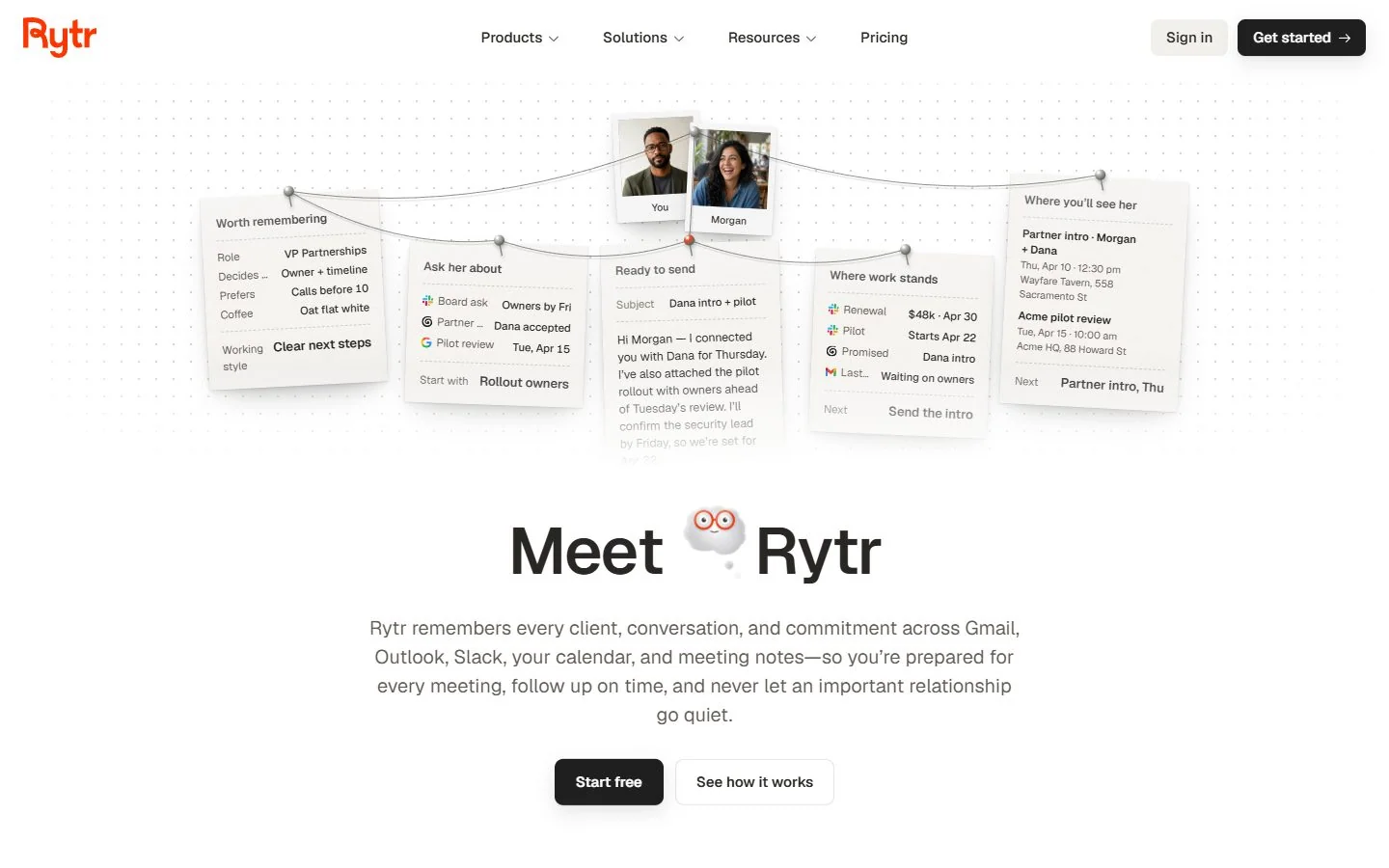
There is an important update to older Rytr vs ChatGPT comparisons. Rytr’s current site distinguishes Create, its writing product, from Engage, its relationship and follow-through workflow. Treating the entire service as an old collection of copy templates misses that distinction. This article primarily compares writing workflows, while explaining when Engage needs a separate evaluation.
We reviewed official documentation on 30 October 2026. We did not run a controlled writing benchmark or use authenticated paid accounts. Feature descriptions are vendor-documented; recommendations and pilot criteria are our editorial analysis. No universal accuracy, originality or speed ranking is claimed.
Who this comparison is for
This guide is for a freelancer, content lead or small team choosing an assistant for recurring written work. It is also useful for an operations team deciding whether a writing subscription duplicates a broader assistant it already owns.
Who should avoid making a decision from this comparison alone? Buyers whose requirements depend on a specific contractual data commitment, integration entitlement or regulated workflow need a current product and contract review. A public feature page cannot establish every term of an organization-specific arrangement.
If you have not defined the work yet, begin with our AI tools evaluation guide . Tool selection becomes easier when “better writing” has an operational meaning, such as fewer unsupported statements or fewer editing rounds before approval.
Rytr vs ChatGPT at a glance
| Decision | Rytr evaluation focus | ChatGPT evaluation focus |
|---|---|---|
| Repeated drafting and rewriting | Create’s writing-oriented controls | A reusable brief and iterative conversation |
| Maintaining context across related work | Voice setup and the relevant Rytr workflow | Projects, files and related chats where available |
| Research-heavy writing | Verify the evidence route for your task | Verify available browsing and source-handling features |
| Relationship follow-through | Evaluate Engage separately | Evaluate your permitted workflow and available connections |
| Team adoption | Whether a bounded process reduces instruction burden | Whether a broad assistant reduces tool switching |
| Quality judgment | Accepted output after review | Accepted output after review |
This is a buying map, not a feature-entitlement table. Check the current plan and account configuration before assuming that a capability visible in documentation is included in the subscription you intend to buy.
What Rytr currently offers for writing
Rytr’s Create page documents drafting, rewriting and adaptation across formats, tones and languages. Its writing-assistant page describes the writing-focused product. These official pages are the basis for the product facts here, rather than older third-party plan descriptions.
The editorial case for a focused writing tool is consistency of process. If your staff repeatedly turn an approved brief into a short reply, an ad variation or a social post, a bounded interface may make the task easier to teach. That is a hypothesis to test with your team, not an independently measured productivity result.
For example, a content lead might provide a verified product fact sheet and require a draft under a specified word limit. The evaluation should observe whether a new contributor can produce an acceptable first pass without inventing benefits or dropping the qualification that matters to the buyer.
The main pros to investigate are a clear writing starting point and repeatable editing instructions. The cons and limitations concern what happens around that starting point. Someone must still supply accurate context, decide which statements are supportable, review tone and confirm that the finished piece fits its destination.
Do not confuse a voice setting with an editorial policy. A model can reproduce a confident tone while making an unsupported claim. Your checklist should state prohibited assertions, required evidence and the human role responsible for approval.
What ChatGPT brings to a writing workflow
OpenAI’s official feature documentation describes work with browsing, files, images and plugins across supported workflows. The projects documentation explains organizing related chats and sources. Availability and behavior depend on the user’s environment and settings.
The editorial attraction is breadth. A writer can discuss the brief, examine supplied material, revise the structure and develop an output within a continuing conversation. This can suit work whose requirements become clearer during the assignment rather than work that always fits a fixed form.
Imagine preparing an internal launch memo from several approved documents. The important evaluation is whether the assistant preserves the difference between confirmed release facts, unresolved questions and proposed messaging. A longer conversation is useful only if it makes those distinctions easier to maintain.
The main pro is the possibility of supporting adjacent work in the same process. The limitation is instruction and review burden. A broad tool gives users more choices about how to approach a task. Your team still needs a consistent brief and a definition of completion.
Do not treat conversational flexibility as proof of better writing. A tool can explore many directions and still miss the required audience or claim boundary. Evaluate the final accepted piece and the work needed to reach it, rather than the apparent intelligence of an intermediate exchange.
Compare the same writing job in both tools
Start with a source packet that is short enough to check manually. Include the audience, purpose, format, length, verified facts and prohibited claims. Make the desired next action explicit: an informative update, a request for review or a customer reply are different writing jobs.
Use one task that reflects your everyday workload and one that exposes a recurring weakness. A straightforward announcement can test basic adherence. A revision containing an ambiguous promise can test whether the process preserves necessary qualifications.
Run more than one sample. A single appealing response is a weak basis for a recurring subscription decision. You do not need a scientific benchmark to make a local purchase, but you do need enough examples to see whether a problem repeats.
Record every change made after generation. Separate factual corrections from style edits, missing instructions and unnecessary additions. This reveals whether a tool’s polished prose is disguising substantial review work.
Use the same acceptance rule for both products. If a piece contains an unsupported product capability, it fails the factual criterion even when the writing reads well. If it meets the facts but misses the audience, it requires revision. Different error types should remain visible.
A practical acceptance rubric
| Criterion | Pass condition | Example failure |
|---|---|---|
| Factual support | Every material assertion traces to the approved packet | Adds a capability that was never supplied |
| Audience fit | Language matches the reader’s knowledge and need | Uses internal terminology in a customer update |
| Constraint adherence | Meets length, format and prohibited-claim rules | Adds a guarantee despite an explicit restriction |
| Useful structure | Reader can locate the key message and next step | Hides the requested action in a long introduction |
| Voice | Matches reviewed examples without copying them | Sounds formal when the brief asks for direct language |
| Editing effort | Reviewer can explain and finish required changes | Needs a complete rewrite despite a polished opening |
Do not average away a serious factual problem with strong style scores. For a small team, a simple pass, revise or reject decision may be more useful than a complex numerical rating. Keep notes explaining why the result received that decision.
Have the reviewer evaluate text without seeing the tool name where practical. This can reduce brand preference during the writing judgment. Restore the tool names when you compare workflow, permissions and administration, because those are part of the purchasing decision.
Brand voice needs examples and exclusions
A voice instruction such as “professional and friendly” is too broad to resolve many editing choices. Provide two short examples of approved writing and explain what makes them suitable. Include sentences your team would reject and the reason for rejection.
For instance, you may prefer a direct opening, concrete verbs and an explicit request. You may reject invented enthusiasm, unnecessary jargon and unsupported promises of improvement. These rules help reviewers distinguish a voice mismatch from a personal stylistic preference.
Test voice across several formats. A service update should not sound exactly like an ad headline, even if both come from the same company. The relevant consistency is the brand’s judgment and vocabulary, not a repeated sentence pattern.
Also test revision behavior. Ask for a shorter version while preserving the same material facts. Check whether the shortened draft quietly removes a caveat or changes a conditional statement into a promise. Editing quality matters as much as the first generation.
Research and factual checking are separate responsibilities
Neither the existence of a writing assistant nor a link in generated text establishes that an assertion is supported. Inspect the original source for consequential facts. When the source is unavailable or ambiguous, narrow the sentence or leave the claim out.
Keep the distinction between research notes and publication text. A note can contain unresolved questions. A published article should not present those questions as verified facts merely because the writing stage has begun.
For research-led content, create a claim ledger containing the assertion, source, checked date and review decision. This need not be elaborate. A short ledger can prevent the same unsupported claim from being regenerated across several formats.
Our explanation of AI hallucinations gives broader context. In a buying pilot, the practical question is how reliably your team catches unsupported material before it leaves the review stage.
Rytr Engage needs a different evaluation
The current Rytr homepage presents Engage around relationships and follow-through, while Create covers writing. If your problem is keeping commitments or preparing for conversations, a narrow copywriting comparison is not enough to judge that workflow.
Define a separate acceptance test. Which source information may be used? Who reviews a suggested action? What happens when the context is incomplete or belongs to a different person? The answer should be visible in the product’s current behavior and documentation before you rely on it.
Do not equate drafting a follow-up with permission to send it. A team should define who can approve an external message and how the final text is checked. This operational rule matters regardless of which assistant prepares the wording.
For this comparison, Engage is a reason to revisit the purchasing brief, not a reason to award Rytr a universal win. Buy a relationship workflow because it solves a verified relationship problem, rather than because it adds attractive items to a writing feature list.
Pricing: compare accepted work rather than a headline fee
Rytr’s current pricing page lists Free, Lite, Personal and Pro. Older plan names or allowances should not be copied into a current purchasing spreadsheet without verification. We omit numeric subscription prices here rather than mix plan generations or assume a reader’s billing arrangement.
For either tool, check the exact account terms you would use. Record included capabilities, relevant usage limits, user access, billing period and any additional purchase needed for the required workflow. A free trial result does not establish the long-term commercial terms.
Then compare the cost of accepted work. An illustrative calculation can include subscription allocation, staff time preparing inputs, review time and administration. Use your own measured time, not vendor claims or an invented industry average.
If one tool produces a draft faster but requires more factual correction, its apparent speed may disappear in editing. If another reduces tool switching but requires extensive setup, include that setup in the pilot period. Cost follows the whole process, not only generation.
Team governance and sensitive material
Before adding internal documents, confirm your organization’s approved use, account configuration and applicable contractual terms. A public product comparison cannot decide whether a particular customer document is appropriate input for your workplace.
Set a simple source rule for contributors: use approved material, remove information that is unnecessary for the task, and keep review responsibility with a named person. An assistant should not become an uncontrolled copy of every document a writer can access.
Design the handoff from draft to publication explicitly. The reviewer should know which facts changed, which sources were used and whether the writer introduced any new claim. Keep the approved final output in the system your team already uses for publishing records.
Test what happens when a contributor leaves. Can another reviewer understand the brief and supporting sources? Can the team recover the final work without depending on one person’s private conversation? These are practical procurement questions even for a small writing team.
A one-week pilot without an artificial winner
Use the first day to define three recurring writing tasks and collect approved source packets. Choose work with different constraints: a short reply, a structured update and a longer explanatory piece. Decide in advance who accepts the final text.
On the next two days, complete equivalent tasks in both workflows. Log preparation, review and revision effort. If a user receives extra coaching for one product, record it; otherwise the comparison may reward training rather than the workflow itself.
Use another day for edge cases. Try incomplete source material, a request that conflicts with the style guide and a revision that must retain a qualification. The correct process should flag uncertainty rather than invent a missing fact to finish the task.
Finish with an editor review and a purchasing discussion. Keep the decision narrow: choose one workflow for a defined task, retain the other for a different purpose, or postpone the purchase because the existing process already works. A trial does not need to crown a universal winner to produce a useful decision.
Decision guidance
Check the hardest revision before committing
Take an otherwise acceptable draft and request a shorter version that must retain a significant qualification. For example, an internal proposal may describe a possible launch date rather than an approved commitment. Ask the reviewer to inspect whether the shorter text preserves that distinction. This is an illustrative test, not an output observed from either product.
Next, provide a conflicting instruction, such as asking for a bold promise while the approved fact sheet prohibits guarantees. The right workflow should make the conflict visible to the human reviewer. Do not reward an assistant for satisfying the latest style request by violating the source boundary.
Save the final prompt, source packet and editorial decision for each case. At renewal time, rerun the same examples with current product behavior and account terms. This is more informative than relying on a favorable impression from an old trial or on a comparison written for a previous product generation.
Shortlist Rytr when a focused drafting and rewriting environment matches the work your team repeats. Shortlist ChatGPT when the assignment benefits from broader conversation and surrounding research or document work. Evaluate Engage separately when relationship follow-through is the actual requirement.
If both pass the same acceptance rules, choose the workflow your team can operate consistently and administer responsibly. If neither passes, improve the brief and review process before buying more software. The winning output is the piece your reviewer can approve with confidence, not the first response that sounds finished.
Frequently asked questions
Is Rytr better than ChatGPT for writing?
Rytr is worth evaluating for a focused drafting and rewriting process. ChatGPT is worth evaluating when writing sits inside broader research and analysis. Neither is a universal quality winner.
Does Rytr still focus only on AI copywriting?
The current official site separates Create writing features from Engage relationship and follow-through workflows. Evaluate the relevant product rather than relying on older comparisons.
Which tool is cheaper?
Compare current account terms and the total cost of accepted work, including editing, verification and administration. This comparison does not reproduce subscription prices.
Can either tool publish content without review?
Generated text should pass factual, legal, brand and editorial checks before publication. A writing tool does not establish that a claim is supported.
How should I run a fair comparison?
Use the same source packet, audience, constraints and acceptance rubric. Compare several real tasks and record editing and fact-checking time.