Suno vs ChatGPT: Which Is Better?
Compare Suno and ChatGPT for song audio, lyrics, creative briefs, downloads, and release checks. Choose the workflow that fits the deliverable you need.
Suno vs ChatGPT is primarily a choice between creating song audio and preparing the words, ideas and instructions around a song. Suno presents a dedicated music-generation product. ChatGPT documents a broader environment for conversation, writing, files and projects. Choose Suno to evaluate a song-generation workflow; choose ChatGPT to evaluate a flexible writing assistant. A strong lyric draft is not the same deliverable as a downloadable, commercially usable recording.
Research scope and limitations
- Research type
- Official-source documentation review and editorial analysis
- Hands-on tested
- No
- Last verified
- November 3, 2026
- Limitations
- No hands-on benchmark. Proposed tests and recommendations are editorial analysis. Paid numeric pricing and unreviewed entitlements excluded.

Table of contents
Direct answer: choose the deliverable before choosing the tool
Suno vs ChatGPT is primarily a choice between creating song audio and preparing the words, ideas and instructions around a song. Suno presents a dedicated music-generation product. ChatGPT documents a broader environment for conversation, writing, files and projects. Choose Suno to evaluate a song-generation workflow; choose ChatGPT to evaluate a flexible writing assistant. A strong lyric draft is not the same deliverable as a downloadable, commercially usable recording.
This comparison reviews official sources on November 3, 2026. We did not run a listening test, compare musical quality, measure generation speed or test paid accounts. Product descriptions are documented facts. The project examples, pilot exercises and decision framework are editorial analysis. We do not claim that one tool is universally more creative or that either output is automatically cleared for a commercial release.
The distinction matters for a songwriter, video producer or marketing team working toward a deadline. You may need a lyric, a musical demo, a final recording or simply a better creative brief. Each has different acceptance conditions. Start with the AI Tools evaluation guide if you are still deciding which part of the process needs help.
Suno vs ChatGPT at a glance
| Decision | Suno | ChatGPT | Your acceptance question |
|---|---|---|---|
| Primary scope reviewed here | Dedicated song creation | Conversation, writing and project work | Do you need audio or preparatory text? |
| First useful exercise | Generate a song from a controlled brief | Develop and revise a lyric or production brief | Can you inspect the deliverable directly? |
| Output assessment | Listen for musical and lyric fit | Review wording, structure and instruction quality | What makes the result acceptable? |
| Delivery boundary | Check the plan’s download allocation | Do not assume a lyric becomes a recorded song | Can the actual required file be delivered? |
| Commercial use | Check current terms and applicable permissions | Review the rights in all supplied and generated material | Is the planned use actually cleared? |
| Cost comparison | Separate credits, downloads and plan terms | Confirm the account’s current plan and limits | What does one accepted deliverable cost? |
Sources: Suno’s official product page , Suno pricing , Suno terms and ChatGPT feature documentation . The acceptance questions are our proposed evaluation method. This is a workflow comparison, not an audio-quality ranking.
What Suno offers in the scope of this comparison
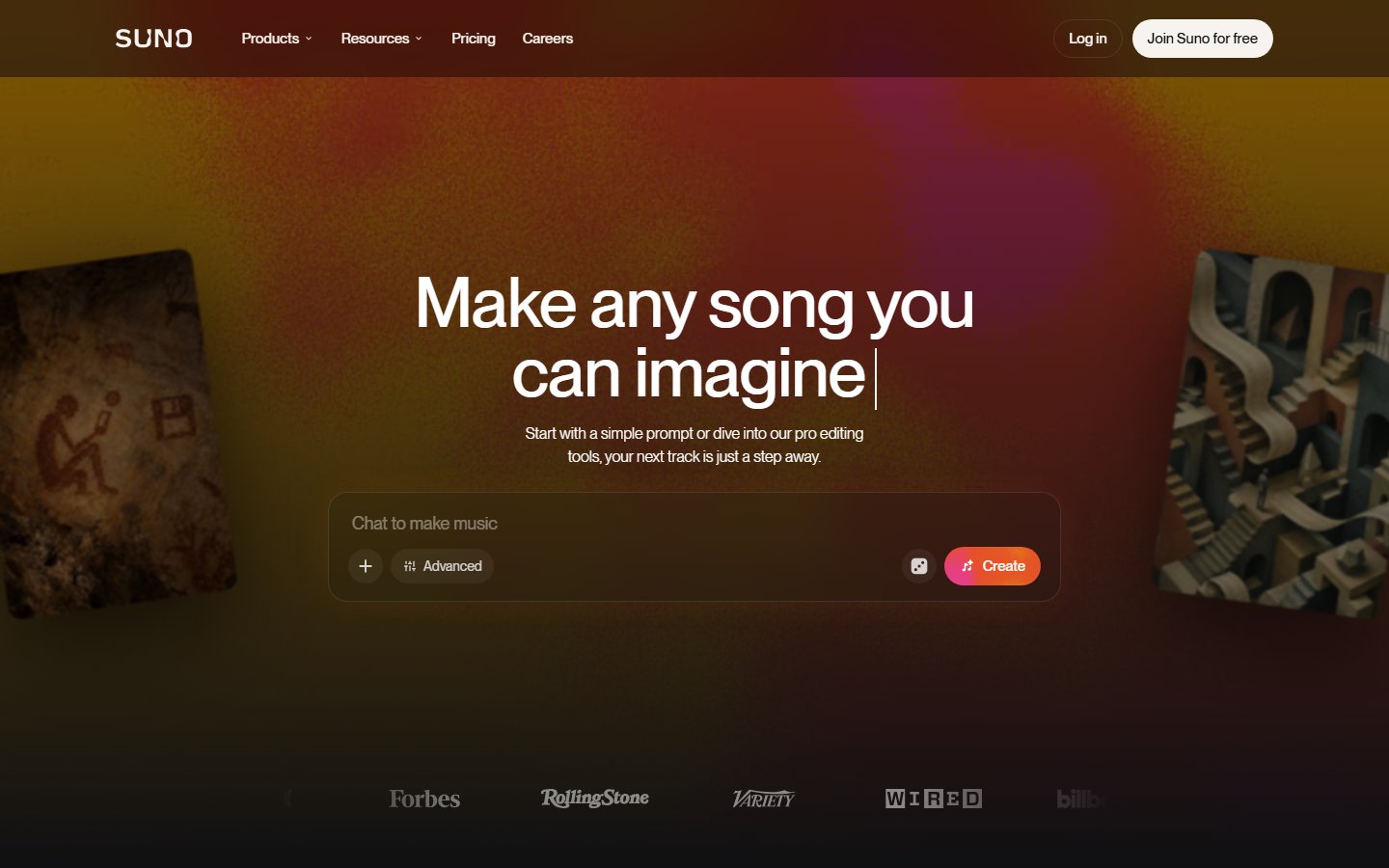
Official public homepage, captured November 3, 2026. Purpose: identify the product discussed in this section, not prove free-tier entitlements. Source .
Suno’s public site presents a product for creating songs. Its current pricing page distinguishes models, generation credits, editing features and song downloads. These are different dimensions of an offer. Access to a creation tool does not establish that every generated item can be downloaded, used commercially or delivered under the conditions your project requires.
That makes Suno the more direct candidate when the next milestone is a musical output. A producer can listen to a proposed direction and decide whether it suits the project. That conclusion follows from the documented product purpose; it does not mean a particular generation will match the brief, sound professional or need no editing. Those are questions for your own controlled evaluation.
Define the audio requirement before using credits. For a private concept exercise, you might need a short example that conveys mood. For a client project, you might need a permitted download, a particular delivery format and documented rights. The second task has more gates even if the initial creative prompt looks identical.
Also define what the product is not being asked to decide. It cannot substitute for the client’s approval of a direction, your review of submitted material or the release requirements of a distributor. Keep the creative decision and the delivery decision visible. A pleasing preview can still be unsuitable for the intended use.
What ChatGPT offers in the scope of this comparison
The official ChatGPT documentation describes writing-related work, conversation, files and projects. These support a broader preparatory process: discussing a concept, organizing a brief, drafting text or revising supplied material. This review does not establish a dedicated song-generation or song-export capability for ChatGPT. Do not purchase or plan a project on that assumption.
A useful exercise is to ask for several approaches to a lyric’s central idea. You can inspect which version communicates the intended meaning, where a line becomes awkward and whether the structure supports the story. The value is in the written exchange and your ability to direct it. We have not tested whether the resulting lines sing naturally or improve a finished composition.
Projects can provide an organizational setting for related work, but organization is not proof of correctness. Keep the approved brief distinct from discarded ideas. If an early conversation explores a humorous direction and the client later approves a serious one, the current source of authority should be easy to identify. Otherwise you are asking the assistant to infer a creative decision you have not recorded clearly.
For more general context, see our ChatGPT review and guide to using ChatGPT . Here the narrower comparison is whether your next step calls for preparatory text or a music-focused production environment.
Separate the four decisions in a music project
Treat the project as four linked decisions: concept, text, sound and permission. The concept defines what the work should communicate. The text includes lyrics and instructions. The sound is the actual recording. Permission determines whether the material and output may be used in the intended way. Passing one decision does not pass the others.
Imagine a fictional community event that needs a theme tune. The organizer first approves a warm, welcoming direction. Next, the writer develops words that fit the event. Then the producer evaluates musical versions. Finally, the organizer checks the release conditions for the intended channel. This is a proposed workflow, not a claim that either product automatically handles every stage.
The separation helps when stakeholders disagree. If the words are approved but the arrangement feels wrong, do not reopen the whole brand brief. Identify the sound requirement that failed. If a recording is creatively accepted but its use is not cleared, do not call it finished. The remaining task is delivery permission, not another round of lyric polishing.
Write each acceptance condition in the brief. “Make it catchy” is difficult to assess consistently. “The event name must be intelligible, the tone must be welcoming and the final line must invite participation” gives reviewers observable criteria. Musical taste still matters, but explicit conditions prevent avoidable misunderstandings from being mistaken for a tool limitation.
Current Suno plan boundaries need fresh verification
Suno’s current pricing page lists no monthly song downloads and no commercial rights on the Free tier. The paid offer separately lists generation credits and download allocations. Do not equate the number of generations with the number of files you can deliver. Check the exact plan and billing basis in the current offer before committing to a project.
Its terms reviewed here have an effective date of September 3, 2026. They condition permitted commercial exploitation on the relevant access and use requirements and a permitted download. This is a description of the source, not a legal clearance opinion. The terms also contain specific treatment for some collaborative or remix outputs. A broad statement that all paid output is unrestricted would omit relevant conditions.
For practical evaluation, keep a record of the plan, creation context, source inputs and intended download. If a project depends on a feature or permission that is unclear, obtain a precise answer from the vendor before promising delivery. An old help article or search snippet is a poor basis for a new commitment when the live offer has changed.
We deliberately exclude exact paid prices here. Billing periods, taxes, entitlements and promotions complicate a number that appears simple in a comparison table. The decision is whether the plan covers your actual output and use, not whether a headline monthly figure looks smaller than another subscription.
A controlled pilot for Suno
Create a short brief containing the audience, mood, subject, required words and prohibited content. Use only material you are entitled to submit. Keep the first exercise separate from a client deadline so that an unsuitable result does not create pressure to skip review. Decide in advance whether the exercise is for private evaluation or a potential release.
Generate a small set of candidates within the current account’s limits. Label each with the brief version and the input used. Listen against the same criteria rather than changing the target after each result. If one version sounds appealing but obscures a required word, record both observations. A single overall reaction can hide a defect that matters to the project.
Review the output in its actual context. A tune that seems energetic in isolation may compete with a voice-over or distract from a spoken message. Use an authorized preview process appropriate to your project. We are proposing that contextual review; we are not claiming to have measured how Suno performs in it.
Before treating a candidate as deliverable, check download availability and applicable terms. Record any outstanding permission question as an open item. Do not rename it “final” merely because the creative team likes it. The workflow is complete only when the required creative and delivery conditions are both satisfied.
A controlled pilot for ChatGPT
Start from the same approved concept, but ask for a written deliverable. For example: propose three lyric outlines for the fictional event, each with a different central image and a plain explanation of the intended emotional arc. Request alternatives before a polished lyric so you can choose the direction explicitly.
After selecting an outline, ask for a short draft with measurable constraints. State the required event name, the audience and any words to avoid. Ask the assistant to identify lines that may be difficult to sing rather than declaring the text performance-ready. That is a review prompt, not a guarantee that the assistant can validate musical fit.
Read the draft aloud and revise it yourself or with a musician. A line can be grammatically smooth and still place stress awkwardly. Keep a list of accepted changes instead of asking for an unrestricted rewrite every time. This makes it easier to preserve the parts you liked while fixing a specific defect.
Finally, evaluate the usefulness of the conversation. Did it make the brief clearer? Did it expose a missing decision? Did you spend more time repairing generic wording than developing your own idea? Those questions support a practical purchase decision without pretending that an editorial conversation is a substitute for a completed recording.
How to combine the tools without losing control
A combined process can make sense when written development and audio exploration are separate jobs. One possible sequence is to approve a brief, develop a lyric draft, verify the right to use the inputs, explore musical versions and review the chosen output against delivery conditions. This is an editorial workflow suggestion, not a verified integration between Suno and ChatGPT.
Keep a clear version boundary at each handoff. The lyric sent into a musical exercise should be the approved version, not the latest experimental response. The producer should know which words may change and which are fixed. If the audio process produces a variation that changes the message, return that variation for review rather than quietly replacing approved copy.
Avoid unnecessary duplication. If the original brief is already strong, another assistant conversation may add little. If you only need a lyric idea and will work with a human composer, a music-generation subscription may not address the bottleneck. Choose the smallest process that produces the required result with review effort you can sustain.
Strengths, limitations and buying advice
Suno’s documented strength for this decision is its direct music-creation focus. The limitation is that a created song still needs creative assessment and plan-specific delivery checks. ChatGPT’s documented strength is a flexible written working environment. The limitation in this evidence set is that text preparation does not establish a song-audio deliverable. Neither statement is a measured quality verdict.
Use this selection table to make the distinction concrete:
| Your immediate need | Candidate to evaluate first | Evidence to collect |
|---|---|---|
| Explore a musical direction | Suno | Acceptable preview and current delivery conditions |
| Clarify a creative brief | ChatGPT | A brief with fewer unresolved decisions |
| Develop lyric alternatives | ChatGPT | Useful text that survives human review |
| Produce a potentially releasable song | Suno, with separate rights review | Accepted output, permitted download and applicable clearance |
| Manage an end-to-end client commission | A defined production process | Owners and acceptance records for every stage |
The last row is deliberately a process choice. A tool does not remove responsibility for the work. If you need a particular performance, an exclusive composition or a specific contractual assurance, make those requirements explicit and verify that the proposed workflow can meet them before spending time on generations.
Compare cost per accepted result
Subscription cost alone gives an incomplete picture. Track the time spent preparing inputs, reviewing candidates, making revisions and confirming delivery conditions. For an audio exercise, also distinguish generation attempts from usable downloads. For a writing exercise, distinguish raw drafts from text that a reviewer actually accepts.
A hypothetical example makes the arithmetic clearer: if one process produces many candidates but requires extensive repair, its apparent abundance may not help the project. A smaller number of usable results can be more valuable. This is a decision principle, not a report of either product’s performance or a claim that one is cheaper in practice.
Set a stop rule before the pilot. If a defined number of attempts fails to meet the brief, revisit the requirement or change the production approach. Do not keep purchasing capacity simply because the next generation might solve an undefined problem. A useful evaluation ends with a decision, even when that decision is to use a different tool or a human specialist.
Recommendation by workflow
Evaluate Suno first when your immediate job is to explore or create song audio and you can verify the required plan conditions. Evaluate ChatGPT first when your immediate job is to think through a concept, draft words or organize project context. Consider using both only when the handoff solves a specific problem and the extra review remains manageable.
If your project needs a guaranteed release date, confirm the whole path before promising it. That includes creative approval, source permissions, output access, any required editing and the final use conditions. Our comparison does not settle legal rights, distribution acceptance or musical quality for a particular output. It gives you a way to ask the right questions before a subscription becomes a production dependency.
Keep an acceptance record
For every accepted candidate, retain the approved brief version, the supplied material, the reviewer and the intended use. Add the delivery and permission evidence separately from the creative verdict. If the project changes from a private exercise to a public campaign, revisit those conditions before release. A record that was adequate for internal exploration may not answer the new questions. This practice is an editorial recommendation, not a documented automatic feature of either product.
Record any unresolved delivery question beside the accepted creative candidate.
For a broader shortlist, browse the AI Tools category and our free AI tools guide . They address wider software selection rather than a song-delivery decision.
Frequently asked questions
Is Suno or ChatGPT better for making a song?
Suno is the dedicated song-creation candidate in this comparison. ChatGPT is evaluated for writing, conversation and project preparation. Choose according to the deliverable, then test quality and delivery conditions yourself; this guide reports no listening benchmark.
Can I use Suno Free output commercially?
The current pricing page reviewed November 3, 2026 lists no commercial rights on Free. Check current terms and the precise output context before any release. This guide does not provide legal clearance for an individual song.
Are Suno generation credits the same as downloads?
No. The reviewed offer lists credits and song-download allocations separately. Confirm both before promising a deliverable. Creating a candidate does not establish that the required file is available under your plan.
Does this comparison establish that ChatGPT exports finished songs?
No. The reviewed ChatGPT evidence supports writing and related project work, not a dedicated song-export workflow. Do not treat lyric assistance as proof that the required recording can be delivered.
Can I use both tools in one creative process?
A proposed process can develop a brief or lyric before exploring audio. That is a workflow suggestion, not a verified integration. Keep source permissions, approved versions, creative review and release conditions separate at each handoff.