What Is AI Agent? Definition, Examples, and Why It Matters
Learn what an AI agent is, how agents plan and use tools, how they differ from chatbots and automation, examples, risks, and evaluation questions.
Definition
An AI agent is a software system that uses artificial intelligence to pursue a goal, decide on steps, use permitted tools or data, observe results, and take actions on behalf of a user or another system. Unlike a model that only returns an answer, an agent can continue through a multi-step workflow with some degree of autonomy.
Google Cloud defines AI agents as systems that use AI to pursue goals and complete tasks for users, with capabilities such as reasoning, planning, memory, decision-making, and adaptation. IBM similarly describes an agent as a system that autonomously performs tasks by designing workflows with available tools. The exact implementation varies, so the label matters less than the actions, permissions, and controls.
How an AI agent works
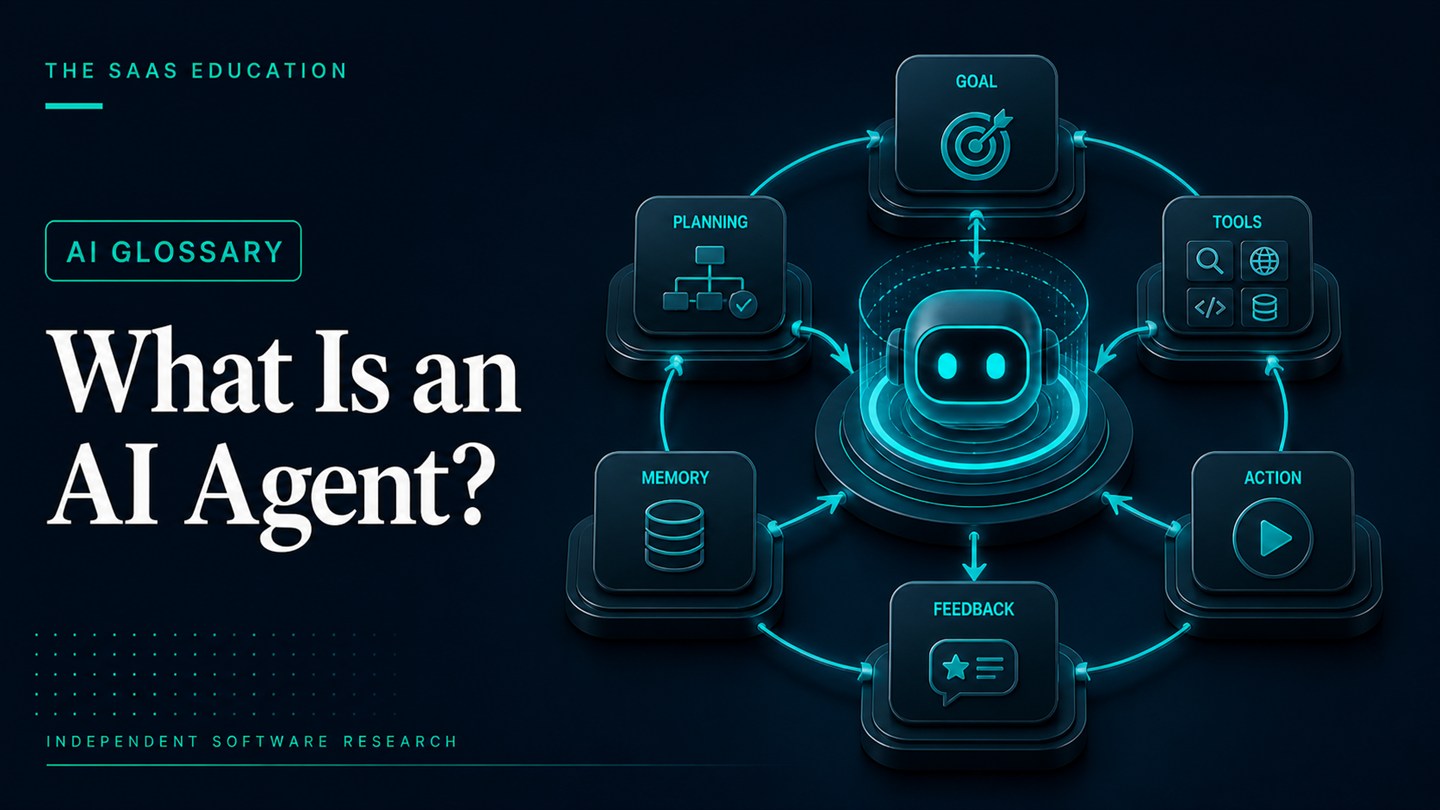
A typical agent includes five functional parts:
- Goal: the outcome supplied by a person, application, or workflow.
- Reasoning or planning: a model interprets the goal and selects the next step.
- Tools: APIs, databases, search, code execution, business applications, or other agents.
- State or memory: information about the task, previous actions, and observed results.
- Control loop: the system acts, observes what happened, revises the plan, and stops or requests approval.
Consider an agent asked to prepare a sales-meeting brief. It might read an approved CRM record, retrieve recent company information, summarize relevant activity, create a draft, and place it in a review queue. Each action should be constrained by data access, source rules, time, cost, and an explicit stopping condition.
The language model does not directly make an external change by producing text. The surrounding system interprets structured output and calls a tool. That boundary is important because tool permissions determine what the agent can actually affect.
AI agent versus chatbot
A chatbot primarily responds within a conversation. It may answer a question, draft text, or explain a topic. An agent can use the conversation as an interface while also carrying out steps in other systems.
For example, a chatbot may explain how to reschedule an appointment. An agent may inspect availability, propose options, and, after required approval, update the scheduling system. The second workflow introduces permissions, side effects, error recovery, and accountability.
The categories overlap. A chatbot can expose agent features, and an agent can communicate through chat. Evaluate behavior rather than relying on a vendor’s label.
AI agent versus automation
Traditional automation follows predefined rules: when a known event occurs, perform a specified action. An AI agent can interpret less structured input and choose among steps or tools based on context.
Rules are often preferable for stable, high-volume, high-consequence processes because they are easier to predict and audit. Agents are useful when the workflow contains ambiguity, changing information, or tasks that require interpretation. Many dependable systems combine both: the agent handles flexible reasoning while deterministic controls enforce permissions, validation, and approvals.
Types of AI agents
- Reflex agents respond to current conditions using defined rules.
- Model-based agents maintain an internal representation of the environment.
- Goal-based agents choose actions that move toward a specified outcome.
- Utility-based agents compare possible actions against a value or cost function.
- Learning agents adapt using feedback or accumulated experience.
- Multi-agent systems coordinate specialized agents, such as a researcher, verifier, and workflow executor.
These categories describe architecture, not quality. A simple deterministic agent can be safer and more effective than an elaborate multi-agent system for a narrow task.
Common AI-agent examples
An IT agent might classify a support request, consult approved documentation, gather diagnostics, and draft a resolution. A sales-research agent might collect permitted account data, identify missing fields, and prepare a brief. A coding agent may inspect a repository, propose a plan, modify files, run tests, and report results. A customer-service agent may retrieve account context and complete low-risk actions under policy.
In each case, the useful question is not whether the product calls itself agentic. Ask what it can read, what it can change, how it verifies success, and when a human must approve.
Why AI agents matter
Agents can connect reasoning with execution. They may reduce handoffs in workflows where people currently gather information, move between applications, and perform repetitive but context-dependent steps.
They also increase the potential impact of an error. An inaccurate answer is different from an inaccurate action that changes a customer record, sends a message, runs code, or spends money. The move from generation to action requires stronger governance.
Risks and controls
Excessive permissions
Give an agent the minimum tools and data required. Separate read and write access, restrict environments, and use short-lived credentials where possible.
Incorrect or manipulated instructions
External content can contain misleading directions. Treat retrieved material as data, not authority. Keep system policy separate and validate tool arguments before execution.
Unbounded activity
Set limits for time, steps, spending, data volume, and retries. Require approval before consequential or irreversible actions.
Weak verification
Success should be checked against an authoritative system state, not merely the agent’s own statement. Preserve logs showing inputs, tool calls, results, approvals, and errors.
Poor recovery
Design idempotent actions where possible, keep rollback procedures, and route uncertain outcomes to a person rather than repeatedly trying new actions.
How to evaluate an AI agent
Ask these questions before adoption:
- What exact goal and users does it support?
- Which systems, tools, and data can it access?
- Which actions can it take without approval?
- How are identity, permissions, and secrets managed?
- How does it verify that an action succeeded?
- What limits stop loops, excessive spending, or repeated failure?
- Can every material action be audited?
- How does a person pause, correct, or roll back the workflow?
- What happens when a tool or model is unavailable?
- Who owns incidents, updates, and periodic review?
Why the distinction matters for buyers
An assistant that drafts a recommendation and an agent that executes it have different risk profiles. Product evaluation should therefore include autonomy, tool scope, data access, approval gates, observability, and recovery, not only model quality.
Choose the least autonomous design that completes the job. Add broader permissions only after a controlled pilot proves that validation and oversight work.
FAQs
What is an AI agent in simple terms?
It is software that uses AI to decide and act toward a goal using permitted tools and information.
Is ChatGPT an AI agent?
A chat model alone is not necessarily an agent. Agentic behavior appears when a surrounding system enables planning, tools, observation, and continued action.
How is an agent different from a chatbot?
A chatbot mainly exchanges messages; an agent can perform steps and change external systems under defined permissions.
Are AI agents fully autonomous?
No. Autonomy varies, and responsible implementations constrain actions and require human approval for higher-impact decisions.
What is the biggest risk?
Giving a probabilistic system consequential permissions without sufficient validation, monitoring, limits, and recovery.
Sources
Frequently asked questions
What is an AI agent in simple terms?
An AI agent is software that pursues a goal by interpreting context, deciding what to do, using permitted tools, and taking one or more actions on a user's behalf.
Is ChatGPT an AI agent?
A chat model alone is not necessarily an agent. It becomes part of an agentic system when it can plan, use tools, observe results, and continue acting toward a goal under defined permissions.
What is the difference between an AI agent and a chatbot?
A chatbot mainly exchanges messages; an agent can use tools and take actions across a workflow with some autonomy. Products can combine both behaviors.
Are AI agents fully autonomous?
Not necessarily. Autonomy exists on a spectrum, and responsible systems restrict tools, data, duration, spending, and high-impact actions while requiring human approval where needed.
What is the biggest AI-agent risk?
The central risk is allowing a probabilistic system to take consequential actions with excessive permissions, weak validation, or insufficient monitoring and recovery controls.