What Is AI Governance? Definition, Examples, and Why It Matters
Understand AI governance, ownership and approval boundaries. Explore a practical example and how voluntary NIST risk-management guidance fits.
AI governance is the system of responsibilities, decisions and controls an organization uses to direct how it develops, buys and uses artificial intelligence. It establishes who may approve an AI use case, what evidence they need, which boundaries apply and who can stop the system when those boundaries fail.
Research scope and limitations
- Research type
- Official-source documentation review and editorial analysis
- Sources reviewed
- 2
- Hands-on tested
- No
- Last verified
- November 11, 2026
- Limitations
- No authenticated account test or performance benchmark. Paid rates and account-specific entitlements not verified; proposed tests and recommendations are editorial analysis.
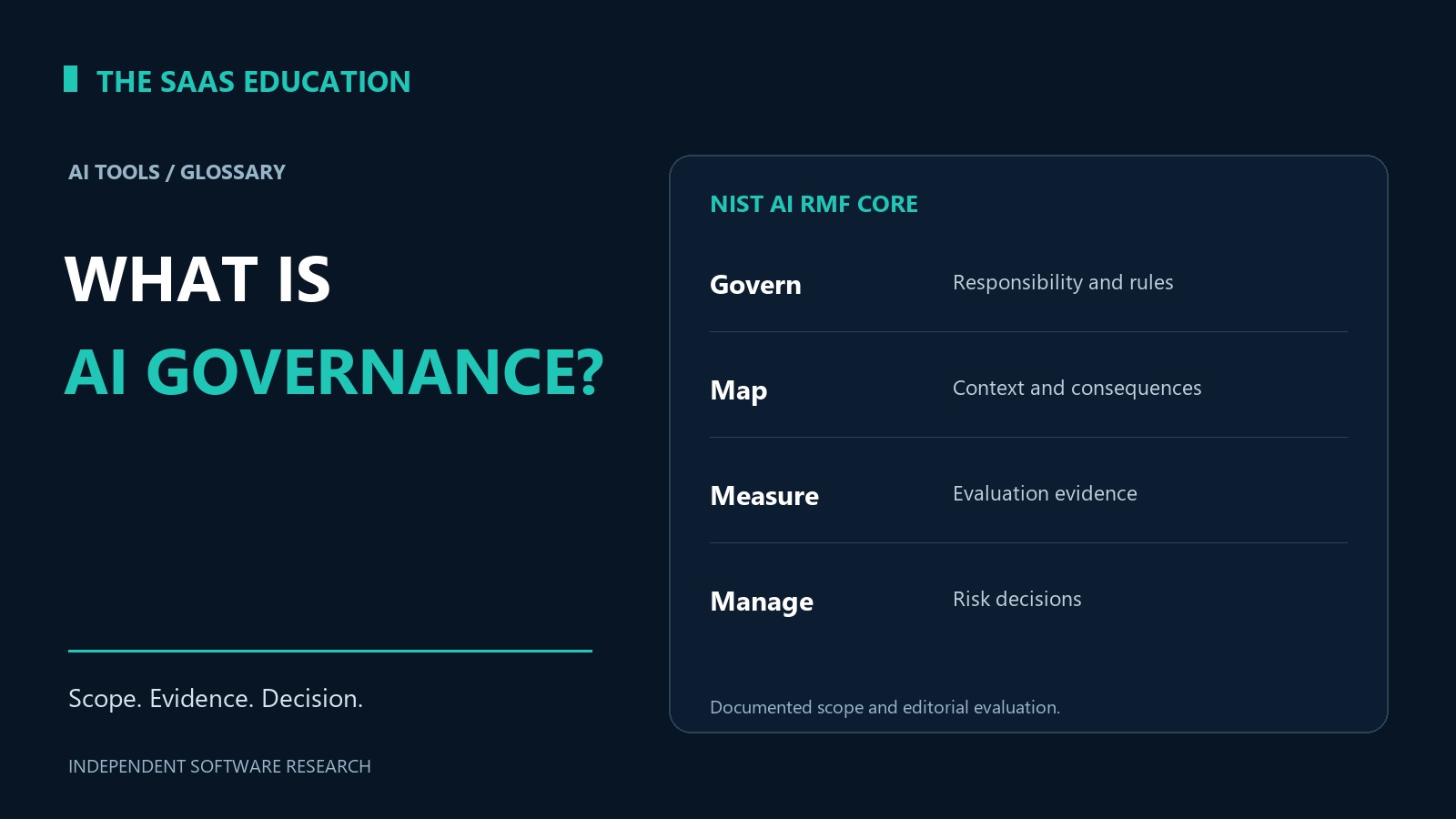
Table of contents
What is AI governance?
AI governance is the system of responsibilities, decisions and controls an organization uses to direct how it develops, buys and uses artificial intelligence. It establishes who may approve an AI use case, what evidence they need, which boundaries apply and who can stop the system when those boundaries fail.
Governance applies to an employee using a writing assistant as well as a company building its own model. Buying a third-party product transfers some technical work to a supplier; it does not answer the organization’s questions about acceptable use, accountability or review.
This definition is broader than a model’s accuracy score. A technically capable system can still be unsuitable for a particular decision, audience or dataset. Our AI tools evaluation guide explains how to assess a proposed tool; governance determines who accepts that assessment and its limits.
Governance, risk management and compliance
These concepts overlap, but they answer different questions.
| Concept | Main question | Example evidence |
|---|---|---|
| AI governance | Who decides, and under which rules? | An accountable owner and recorded approval |
| AI risk management | What could go wrong, and how will it be addressed? | Evaluation findings and a mitigation decision |
| AI compliance | Which applicable obligations must be satisfied? | A review against identified requirements |
| Model evaluation | How does the system behave on relevant tasks? | Results from a defined test set |
A policy document alone does not establish effective governance. Someone must apply it when a new use is proposed, when conditions change and when a problem occurs. Equally, a successful model test is evidence for a decision rather than permission to use the model everywhere.
The NIST AI Risk Management Framework is a voluntary resource for managing AI-related risks. It is not a certificate or a guarantee of legal compliance. NIST currently notes that AI RMF 1.0 is being revised; organizations should identify the version they actually use.
What does AI governance cover?
A useful starting point is the decision being delegated or assisted. A draft meeting summary and an instruction to change a customer’s account have different consequences, even if both use the same underlying model.
Governance therefore connects several kinds of ownership. The business owner explains the intended benefit and affected people. The technical owner describes access, dependencies and failure behavior. Relevant specialists review questions within their expertise. An approval should name the person accountable for the final operating decision rather than referring vaguely to “the team.”
Data boundaries matter throughout that discussion. Identify which information may enter the system, who can see its outputs and where results become records. A generated summary can create a new access problem if it copies restricted information into a widely shared workspace.
Governance also addresses change. A new integration, audience, model version or action permission may make an earlier approval insufficient. An approval needs a scope that people can recognize, not a permanent statement that a product is safe.
A practical example: an internal policy assistant
Consider a hypothetical company evaluating an assistant that answers employee questions from its published travel policy. The proposed benefit is easier access to approved information. It is not permission for the assistant to authorize expenses or invent exceptions.
An illustrative approval record might state:
| Decision field | Example entry |
|---|---|
| Accountable owner | Travel operations lead |
| Permitted purpose | Explain the current published travel policy |
| Information boundary | Approved policy documents; no individual expense records |
| Output requirement | Identify the supporting policy and its version |
| Escalation | Send unclear or exception requests to a named human role |
| Action boundary | No expense approval, payment or account changes |
| Recheck trigger | Policy revision, new data source or changed permissions |
These entries are proposed controls, not observations from a deployed product. They make the decision testable: reviewers can ask whether the assistant cites an obsolete policy, exposes restricted material or claims authority it does not have.
If it repeatedly gives an unsupported answer, the response may be to narrow its scope, improve its evidence or suspend use. Governance makes responsibility for that choice explicit. It does not promise that controls eliminate every error.
How NIST’s core functions fit
The AI RMF core organizes risk-management activity around Govern, Map, Measure and Manage. Govern operates across the other functions; they are not a one-time sequence that ends at launch.
For a small business, the practical implication is continuity. Understanding a use case, evaluating its behavior and responding to problems should remain connected to accountable decision-makers. Keeping evaluation findings separate from the approval record makes it harder to know why a system was allowed into use.
Strengths and limitations
Clear governance can help a team resolve disputed ownership, explain an approval and recognize when a system exceeds its intended role. It also gives employees a route for raising concerns before a problem becomes routine.
The limitation is operating effort. Elaborate forms will add little value if nobody can interpret the evidence or act on it. A small organization should choose a process proportionate to the use and consequences, while retaining meaningful responsibility and review. Neither a framework nor a vendor’s assurance replaces that work.
For action-taking systems, use our AI agent governance checklist for deeper implementation questions. The customer-support AI controls guide provides a more specific service-workflow example. The AI tools category provides related research. Our review methodology explains how documented facts differ from editorial judgments.
FAQs
Does a small business need AI governance?
It needs clear responsibility for the AI it uses. The process can be proportionate: identify the purpose, owner, information boundaries, approval and response to problems. A committee is not a prerequisite for making those decisions explicit.
Is AI governance the same as responsible AI?
Responsible AI describes goals and principles for appropriate development and use. Governance assigns the decisions, responsibilities and evidence needed to put relevant principles into practice. A statement of principles alone does not specify who can approve or stop a system.
Who should own AI governance?
Accountability should sit with people who can make and enforce decisions about the use case. Business, technical and specialist roles may contribute different evidence. Avoid assigning responsibility to a committee without naming who accepts the operating decision and unresolved risks.
Does using the NIST framework prove compliance?
No. It is a voluntary risk-management resource. Applicable obligations depend on the organization, activity and jurisdiction. Using a framework does not by itself establish that those obligations have been identified or satisfied.
When should an AI approval be reviewed?
Review it when material conditions change, including the purpose, affected people, information sources, permissions or observed behavior. Also set an ordinary review date. A quiet system can still become unsuitable when its surrounding process changes.