What Is Fine-Tuning? Definition, Examples, and Why It Matters
Learn what AI fine-tuning means, how it differs from prompting and retrieval, common examples, benefits, risks, and when teams should use it.
Definition
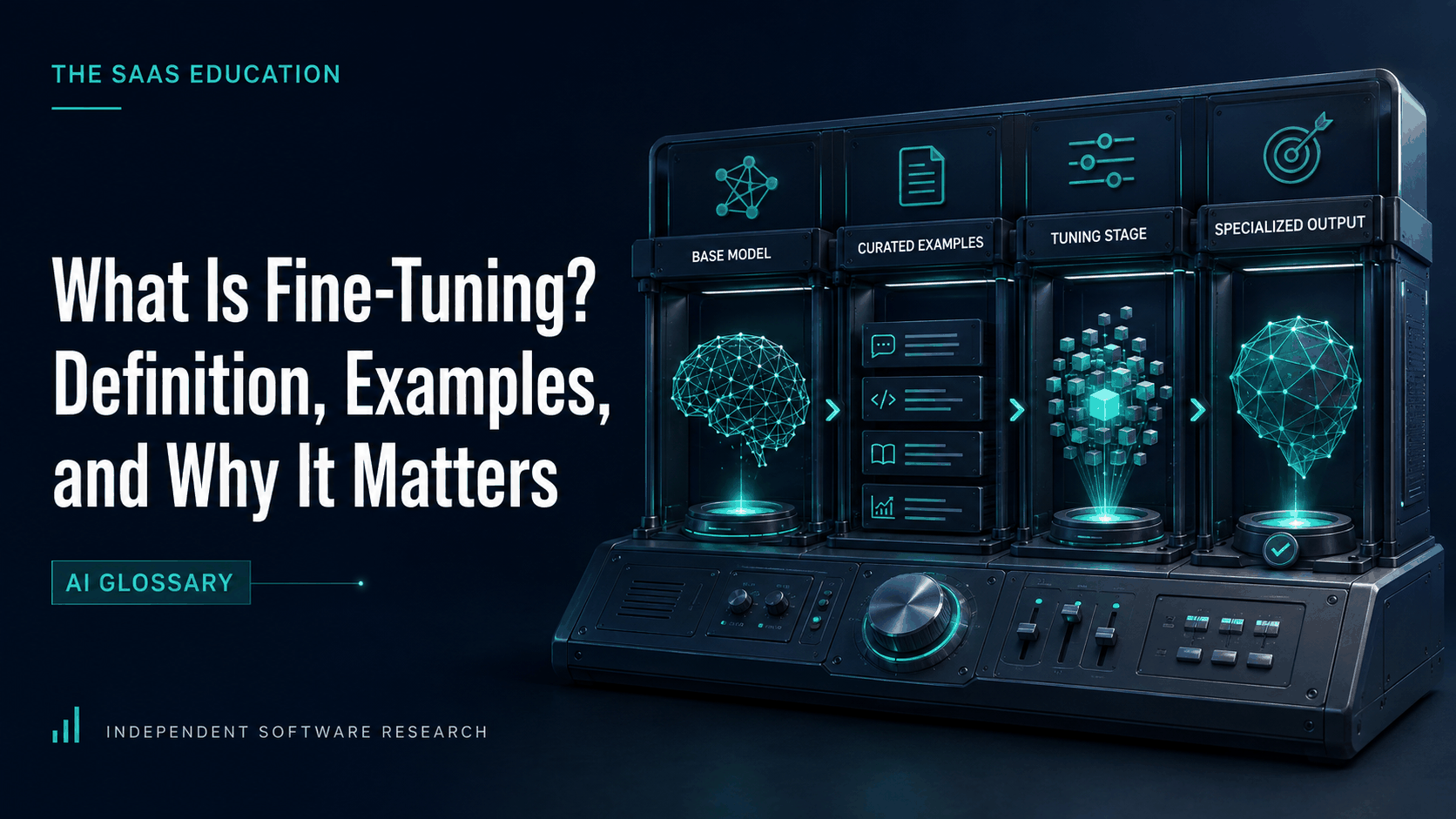
Fine-tuning is an additional training stage that adapts a pretrained machine-learning model to a more specific task, domain, output format, or preferred behavior. Instead of training a model from the beginning, developers start with a model that has already learned broad patterns and train it further using selected examples or feedback.
Google’s machine-learning glossary calls it a task-specific second training pass on a pretrained model. NIST similarly describes adapting a pretrained model with task- or domain-specific information. The resulting model retains broad capability from pretraining while becoming more specialized for the target use case.
Fine-tuning is not simply uploading a document or writing a better prompt. It changes learned parameters or adds trained adapters. The exact method depends on the model and platform.
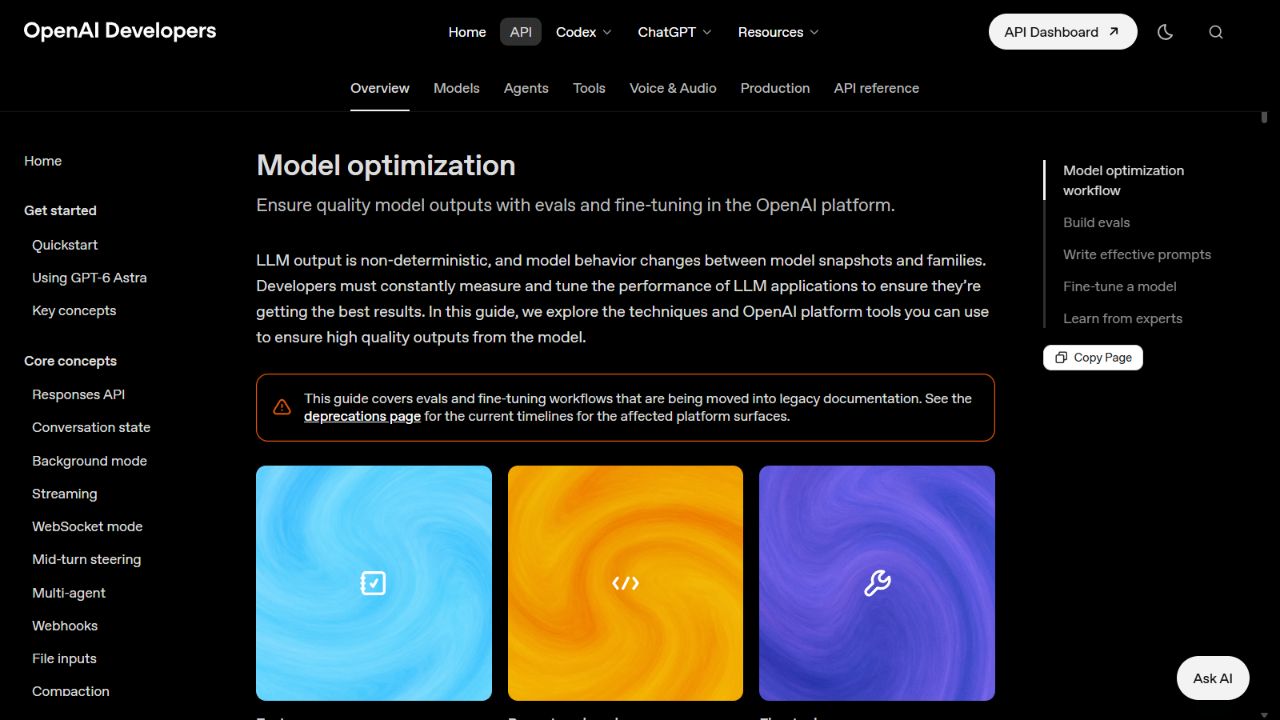
Provider availability is separate from the concept. When checked on September 7, 2026, OpenAI’s current model-optimization documentation said its fine-tuning platform was being wound down for new users and directed readers to deprecation timelines, while documenting continued inference for existing tuned models until their base models are deprecated. Other providers may support different tuning methods. Always verify the selected platform before designing an implementation.
How fine-tuning works
A simplified workflow has six stages:
- Select a supported base model.
- Define the target behavior and success metrics.
- Prepare representative training examples or preferences.
- Run the provider’s tuning job.
- Evaluate the tuned model against held-out test data and the base model.
- Deploy, monitor, and retrain or retire it when conditions change.
In supervised fine-tuning, examples show the desired response for a given input. Preference tuning uses comparisons or feedback to teach which responses are preferred. Full fine-tuning may update all model parameters, while parameter-efficient approaches update a smaller set or train adapter components, reducing compute and storage requirements.
The training data shapes behavior. Inconsistent, biased, duplicated, or unrepresentative examples can create a model that performs well on a narrow test while failing in production.
Fine-tuning vs prompting
Prompt engineering supplies instructions and examples with each request. It is usually faster, cheaper, and easier to change because the underlying model is not retrained.
Fine-tuning can help when a repeated task still produces inconsistent structure, terminology, classification, or style despite a strong prompt. It may also reduce the need to send long examples repeatedly. However, it introduces data preparation, training, evaluation, versioning, and monitoring work.
Start with prompting. Google Cloud’s tuning guidance explicitly recommends optimizing prompts first and moving to tuning when required to improve performance or address recurring errors.
Fine-tuning vs retrieval-augmented generation
Retrieval-augmented generation, commonly called RAG, finds relevant information from an approved source at request time and provides it to the model. It is useful when answers depend on current documents, policies, product catalogs, or other changing knowledge.
Fine-tuning is better suited to learned behavior: how to classify, format, transform, prioritize, or respond. It should not be treated as a database update. A tuned model may reproduce patterns from training, but it does not provide a dependable mechanism for citing and refreshing every factual record.
Many systems combine both approaches: fine-tuning for consistent behavior and retrieval for current evidence.
Fine-tuning vs pretraining and distillation
Pretraining builds broad capability from a very large dataset and generally requires far more compute and data than application teams can justify. Fine-tuning begins from that pretrained foundation and narrows behavior using a smaller specialized dataset.
Distillation trains a smaller model to reproduce useful behavior from a larger model or process. Its objective often includes efficiency, latency, or cost, while fine-tuning primarily adapts behavior to a task. The techniques can be combined.
Examples of fine-tuning
Structured output
A support application may need every response to follow a specific JSON schema. Training examples can reinforce the required fields and format when prompting alone remains inconsistent.
Classification and extraction
A model can be adapted to classify internal ticket categories, identify domain-specific entities, or transform text into a defined taxonomy. Evaluation should include rare and ambiguous cases.
Specialized language and style
Fine-tuning can reinforce approved terminology or a consistent writing pattern. It should not encode deceptive impersonation or replace factual review.
Code and technical tasks
A supported model may be tuned on a bounded programming language, query format, or transformation task. Generated code still requires tests, security review, and human approval.
Preference alignment
Preference data can teach a model which of two outputs better follows domain rules or quality criteria that are difficult to express as a simple label.
Why fine-tuning matters
Fine-tuning can improve consistency on repetitive, measurable tasks. It can reduce prompt length, make specialized output easier to obtain, and adapt a general model to domain conventions. For high-volume workloads, those improvements may reduce correction time or inference cost.
The benefit must be measured against a baseline. A tuned model is not automatically more intelligent or accurate. It may improve the target task while becoming less useful elsewhere. Compare it with the base model using the same representative evaluation set.
Risks and limitations
Training data can contain personal information, confidential material, copyrighted content, bias, incorrect labels, or unsafe examples. Teams need lawful data rights, minimization, access controls, retention rules, and documentation.
Overfitting occurs when a model learns the training examples too closely and fails on new inputs. Data leakage makes evaluation look stronger when test examples overlap training data. Distribution shift occurs when real requests differ from the examples used to tune the model.
Fine-tuning also creates operational responsibility. Teams must track the base model, dataset version, tuning method, evaluation, deployment, incidents, and retirement. A provider may change supported models or deprecate a base version.
When to use fine-tuning
Consider fine-tuning when:
- The task is repeated and clearly defined.
- Prompting and retrieval have already been tested.
- A measurable quality gap remains.
- Representative, lawful, high-quality data exists.
- Success and failure can be evaluated objectively.
- The expected volume justifies training and maintenance.
- The organization can monitor and govern the resulting model.
Avoid it when requirements change weekly, the main problem is missing current knowledge, examples are scarce or unreliable, or nobody owns evaluation and production monitoring.
Practical evaluation checklist
Create separate training, validation, and test sets. Include normal, rare, ambiguous, adversarial, and safety-sensitive inputs. Compare the tuned model with the base model and a well-designed prompt. Measure task success, error severity, formatting, fairness, latency, token usage, cost, and human correction effort.
Review memorization and privacy risk. Test behavior outside the target task to detect regressions. Record the dataset, parameters, provider, model version, date, and approval. Monitor production drift and maintain a rollback path.
Final explanation
Fine-tuning adapts an existing model through additional training. It can make outputs more consistent for a defined task, but it is not a shortcut around clear requirements, good prompts, current evidence, clean data, or evaluation.
Start with prompting and retrieval. Fine-tune only when a recurring measured gap remains and the organization has the data and controls to maintain another model artifact responsibly.
Sources
Frequently asked questions
What is fine-tuning in simple terms?
Fine-tuning is additional training that adapts an already pretrained model to a narrower task, domain, format, or behavior using selected examples or preference data.
Is fine-tuning the same as prompt engineering?
No. Prompt engineering changes the instructions or examples supplied at inference time. Fine-tuning changes model parameters or learned adapters through another training process.
Is fine-tuning the same as RAG?
No. Retrieval-augmented generation fetches relevant external information at request time. Fine-tuning adapts model behavior through training and is not a reliable substitute for frequently changing factual knowledge.
How much data is needed for fine-tuning?
There is no universal number. Requirements depend on the task, base model, method, diversity, labels, and quality. A smaller clean representative dataset can be more useful than a larger inconsistent one.
What are examples of fine-tuning?
Examples include consistent structured output, domain-specific classification, entity extraction, preferred response style, specialized code behavior, and instruction following for a bounded workflow.
What are the risks of fine-tuning?
Risks include memorizing sensitive data, amplifying bias, overfitting, reducing performance outside the target task, stale behavior, weak evaluations, added cost, and difficult governance.
When should a business fine-tune an AI model?
Fine-tune after prompting and retrieval have been tested, a repeated measurable gap remains, representative training and evaluation data exist, and the team can govern deployment and ongoing monitoring.