What Is Generative AI? Definition, Examples, and Why It Matters
Learn what generative AI is, how it works, practical examples, business uses, limitations, and the questions teams should ask before adoption.
Direct answer
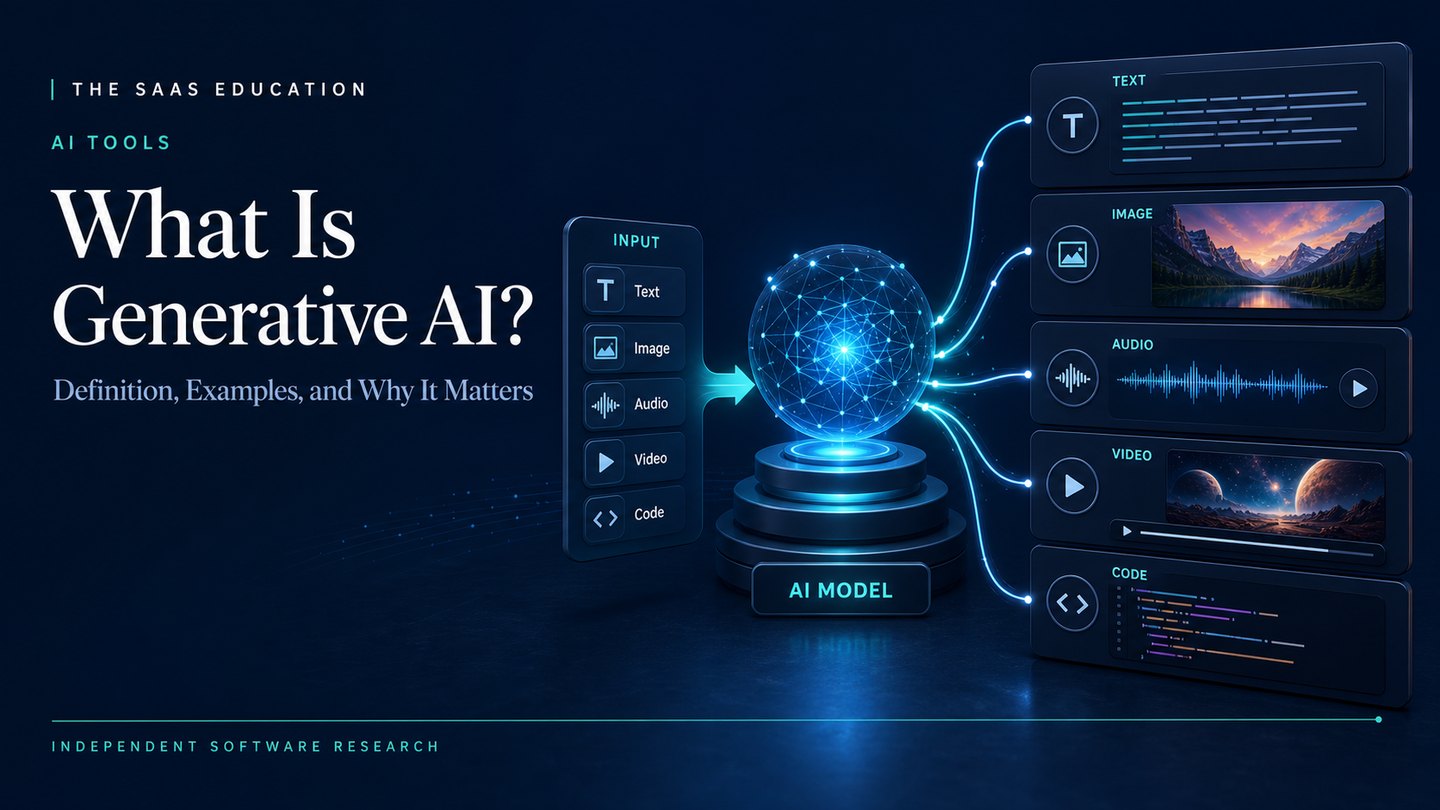
Generative AI is a class of artificial intelligence that learns patterns from data and creates new synthetic content, including text, images, audio, video, and code. A person or system provides an input, and the model produces an output based on patterns learned during training and any context supplied at the time of use.
Generative AI matters because it can reduce the effort required to create a first draft, explore options, summarize material, transform content, or assist with software work. It also creates risks: output can be inaccurate, biased, insecure, infringing, or inappropriate for the task. The useful business question is therefore not simply whether a tool can generate content, but whether the full workflow can be verified and governed.
A plain-language generative AI definition
The US National Institute of Standards and Technology defines generative artificial intelligence as models that emulate the structure and characteristics of input data to generate derived synthetic content. NIST notes that this content can include images, video, audio, text, and other digital material.
In plain language, generative AI identifies patterns in large collections of examples and uses those patterns to produce a new response. It does not retrieve a guaranteed correct answer from a database unless a product explicitly combines generation with retrieval and the answer is verified against the source.
How generative AI works
A simplified workflow looks like this:
- Training: A model learns statistical relationships from training data.
- Input: A user or another system provides a prompt, image, file, instruction, or structured request.
- Generation: The model predicts and assembles an output that fits the input and learned patterns.
- Review: A human or controlled system checks whether the output is accurate, safe, useful, and permitted.
- Use or revision: The output is edited, approved, rejected, or passed into another workflow.
The review step is not optional for material decisions. A fluent answer may still contain errors because generation optimizes for a plausible response, not guaranteed truth.
Common examples of generative AI
Text generation
Text systems can draft emails, outlines, summaries, product descriptions, meeting notes, or code explanations. They are useful for accelerating a first draft, but factual claims and source interpretation need review.
Image generation and editing
Image tools can create new visuals from prompts, replace backgrounds, extend a scene, or produce design variations. Brand, rights, representation, and accessibility still require human judgment.
Audio and video generation
Generative systems can create speech, music, clips, translations, dubbing, or video variations. Consent, likeness, provenance, and disclosure become important when output resembles real people or events.
Code generation
Coding assistants can suggest functions, tests, documentation, or fixes. Generated code should be reviewed, tested, and scanned like human-written code because it can contain security and logic defects.
Document and data assistance
Some products summarize files, answer questions about documents, or help interpret structured data. The quality depends on access to the correct source material, permissions, and the ability to trace conclusions back to evidence.
Generative AI vs traditional predictive AI
| Question | Predictive or discriminative AI | Generative AI |
|---|---|---|
| Typical output | Classification, score, forecast, or decision support | Newly generated text, image, audio, video, or code |
| Example | Predict whether a customer may churn | Draft a retention email or conversation summary |
| Main review need | Validate model accuracy and decision impact | Validate content accuracy, safety, provenance, and suitability |
The categories can overlap. A modern product may classify an input, retrieve information, and generate a response in the same workflow.
Why generative AI matters to software buyers
Generative AI is becoming a capability inside many software categories rather than a separate category by itself. CRM, support, marketing, design, productivity, development, finance, and HR products may all include generation.
That changes procurement in three ways:
- A feature is not a workflow. A vendor can list AI generation without showing how output is reviewed or connected to work.
- Usage can create new costs. Plans may use credits, consumption limits, premium models, or per-user licensing.
- Data and accountability matter. Buyers must understand what data the feature can access, who reviews output, and what happens when it is wrong.
Use our AI tools practical evaluation guide to compare products and How to Choose AI Tools to plan a shortlist.
Benefits when the workflow is well designed
Generative AI can help teams:
- create a usable first draft faster;
- summarize large amounts of approved material;
- produce variations for human review;
- translate or reformat content;
- make specialized software easier to operate through natural language;
- automate low-risk steps while keeping accountable approval.
These benefits are context-dependent. Time saved at generation can be lost during correction if the task lacks good source material or clear acceptance criteria.
Limitations and risks
Inaccurate output
Generated claims can be false even when they sound confident. Important facts need source verification.
Bias and unsuitable content
Models can reproduce patterns and biases from data or produce material that is inappropriate for the user, audience, or jurisdiction.
Privacy and confidentiality
Entering personal, customer, client, or company information may create policy or contractual risk. Teams need approved tools and data rules.
Intellectual property and provenance
The right to use an output depends on product terms, source material, jurisdiction, and context. Content Credentials and provenance systems can help, but they do not replace legal review.
Security
Generated code, automated actions, and connected agents can introduce vulnerabilities or perform unintended steps. Apply access controls, testing, logging, and human approval.
A practical evaluation checklist
Before adopting a generative AI feature, ask:
- What exact task should improve?
- What approved data can the system access?
- Can the output cite or link to its source?
- Who is accountable for review?
- What errors would create material harm?
- How are usage, users, and costs controlled?
- Can the workflow be stopped or rolled back?
- How will the team measure quality and time saved?
For automated work, also use the AI agent governance checklist and the AI agent tools evaluation guide .
Teams moving from definitions to implementation can continue with the AI workflow automation guide and the AI productivity stack guide .
Sources checked
- NIST glossary: generative artificial intelligence
- NIST SP 800-218A: Secure Software Development Practices for Generative AI
- NIST AI Risk Management Framework
- NIST Generative AI Profile
- OECD AI principles
- C2PA technical specification
Why it matters
Generative AI can make software more capable and easier to use, but it also moves content creation and decision support closer to systems that can be confidently wrong. The organizations that benefit most will connect generation to reliable sources, clear ownership, controlled data access, and practical review rather than treating the first output as the finished answer.
Frequently asked questions
What is generative AI in simple terms?
Generative AI is software that learns patterns from data and produces new synthetic content, such as text, images, audio, video, or code, in response to an input.
What are examples of generative AI?
Examples include tools that draft text, generate images, create or edit audio and video, produce code, summarize documents, or build design variations.
Is generative AI the same as ChatGPT?
No. ChatGPT is a product that uses generative AI models. Generative AI is the broader class of technology used across many products and content types.
What is the main risk of generative AI?
A central risk is that generated output can be plausible but inaccurate, unsafe, biased, or unsuitable for the intended context. Human review and source verification remain necessary.