What Is Large Language Model (LLM)? Definition, Examples, and Why It Matters
A plain-language explanation of large language models, how LLMs work, common examples, business uses, limitations, and evaluation questions.
Definition
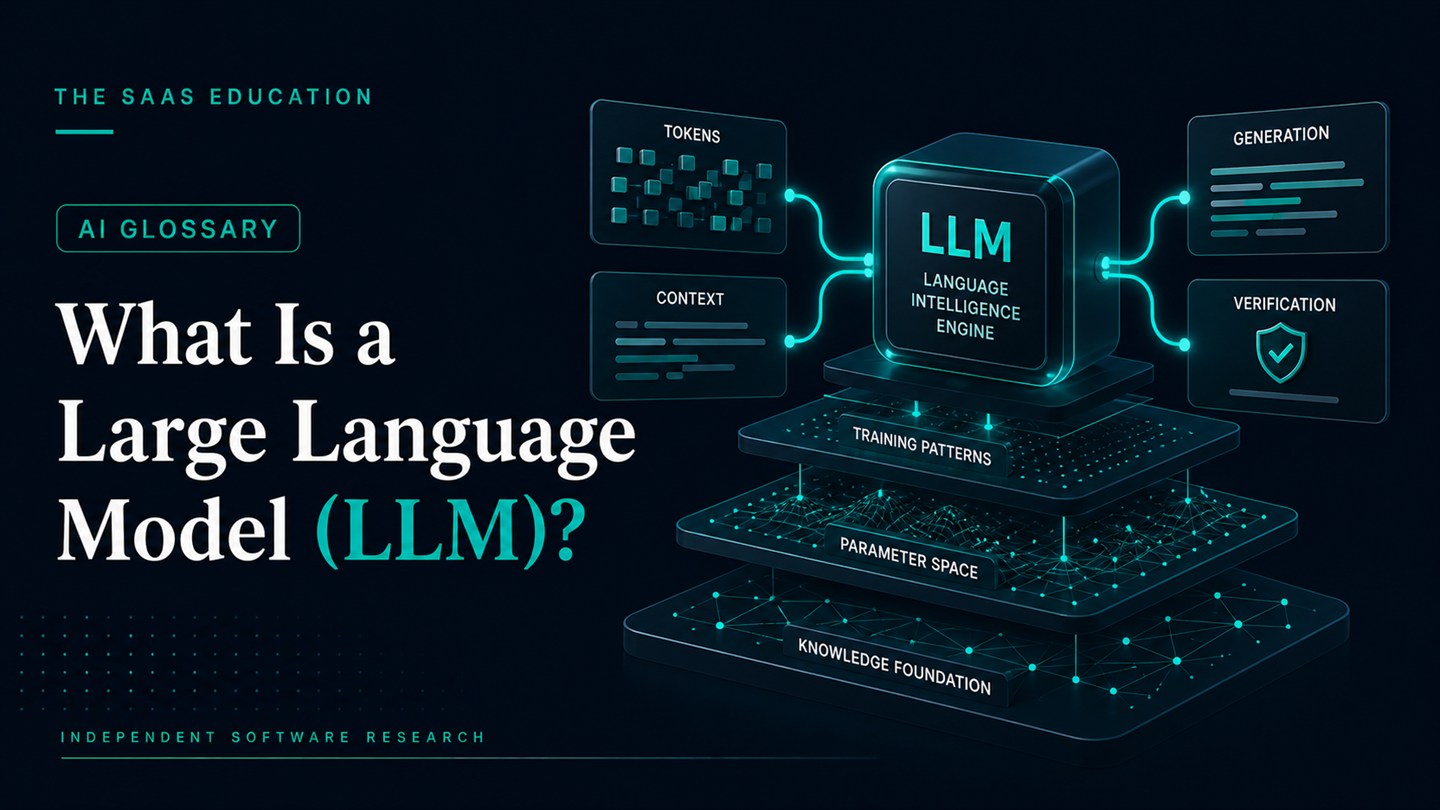
A large language model (LLM) is a machine-learning system trained on large collections of text and related data to predict and generate sequences of language. It can summarize, classify, translate, answer questions, draft content, extract information, and support other language-based tasks.
The word large can refer to the amount of training data, the number of model parameters, the computing resources used, or a combination of these factors. There is no single universal size at which a language model officially becomes an LLM.
How an LLM works
An LLM processes text as units called tokens. A token may represent a word, part of a word, punctuation, or another text fragment. During training, the model learns statistical relationships between tokens and patterns across many examples.
When a user enters a prompt, the model estimates which token should come next, then repeats that process to form a response. Modern systems use transformer architectures, which help models consider relationships across the input rather than reading only one adjacent word at a time.
This mechanism explains both the usefulness and the risk. An LLM can produce coherent language because it has learned complex patterns. It does not automatically guarantee that each sentence is true.
LLM, chatbot, and AI application are not the same thing
These terms are often mixed together:
- LLM: the underlying language model.
- Chatbot: an interface or application for exchanging messages.
- AI assistant: a product that may combine an LLM with search, files, memory, tools, policies, and integrations.
- AI agent: a system that can use a model to plan or take actions through tools under defined controls.
ChatGPT, Claude, Gemini, and other products are applications built around models and supporting systems. A product update can change the interface, tools, or model without changing every other layer.
Common LLM uses
Businesses use language models for:
- drafting and revising documents;
- summarizing meetings or long files;
- classifying support conversations;
- extracting structured fields from text;
- answering questions over approved knowledge;
- translating and localizing material;
- generating or explaining code;
- assisting research when connected to verifiable sources.
The correct use depends on error cost. A brainstorming task can tolerate more uncertainty than a legal clause, financial report, security action, or customer-facing policy.
Why LLMs matter for SaaS buyers
LLMs are increasingly embedded in CRM, support, marketing, productivity, analytics, and developer software. Buyers therefore need to evaluate more than whether a product includes an “AI” feature.
Important questions include:
- Which model or provider supports the feature?
- What data is sent to the model?
- Is customer data used for training?
- Can administrators control access and retention?
- Does the system cite or retrieve approved sources?
- What happens when the model is wrong?
- How is usage priced and limited?
An AI feature can improve a workflow without being appropriate for every data type or decision.
The main limitations
Hallucination
An LLM may generate a plausible but unsupported answer. Retrieval, citations, and human review can reduce risk, but they do not make every output correct.
Stale knowledge
A model’s training data has limits. Current information requires retrieval or tools connected to recent sources.
Bias and uneven performance
Training data and evaluation choices can produce different results across languages, topics, and user groups. Teams should test their own representative cases.
Privacy and security
Prompts may contain confidential information. Buyers should review provider terms, retention, access controls, regional processing, and administrative settings before use.
Cost and latency
Larger or more capable models can cost more and respond more slowly. A smaller model may be sufficient for classification or extraction.
LLM versus generative AI
Generative AI is the broader category of systems that create new text, images, audio, video, code, or other outputs. An LLM specializes in language and may also work with images or audio when built into a multimodal system.
Not every generative AI model is an LLM, and not every AI feature uses generative AI.
How to evaluate an LLM-powered feature
Start with the job rather than the model name.
- Define the expected input and output.
- Create representative test cases.
- Record the cost of false or incomplete answers.
- Require sources for factual tasks.
- Test permissions and sensitive-data handling.
- Compare quality, latency, and total usage cost.
- Define when human review is mandatory.
- Monitor changes because providers update models frequently.
The best model on a public benchmark may not be the best system for a specific workflow. Product design, retrieval quality, integrations, governance, and support can matter just as much.
Frequently asked questions
What is a large language model in simple terms?
It is a system that learns patterns from large amounts of language data and uses those patterns to understand or generate text.
Is ChatGPT an LLM?
ChatGPT is an application powered by language models. The product includes an interface and additional tools around the underlying models.
Why do LLMs hallucinate?
They predict likely language rather than reading from a guaranteed factual database. A confident answer can therefore be incorrect.
Can an LLM access current information?
It can when the application connects it to search, databases, or retrieval systems. The underlying model alone may have a knowledge cutoff.
How should a business evaluate an LLM?
Test the real workflow for accuracy, source support, security, privacy, cost, latency, integration fit, and the impact of errors.
Sources: Google Research: Attention Is All You Need , IBM: What are large language models? , NIST AI Risk Management Framework , OpenAI documentation , and Google Cloud: LLM overview .
Frequently asked questions
What is a large language model in simple terms?
A large language model is a machine-learning system trained on large collections of text and related data to predict and generate sequences of language.
Is ChatGPT an LLM?
ChatGPT is an application that uses language models. The application and the underlying model are related but not identical.
Why do LLMs hallucinate?
LLMs generate likely sequences rather than consulting a guaranteed factual database, so fluent answers can contain unsupported or incorrect claims.
Can an LLM access current information?
Only when the application provides tools or retrieval systems that connect the model to current sources. The base model alone may not know recent information.
How should a business evaluate an LLM?
Evaluate task accuracy, source support, security, privacy, cost, latency, integration fit, governance, and the consequences of an incorrect answer.