What Is Prompt Engineering? Definition, Examples, and Best Practices
Prompt engineering is the practice of designing instructions and context that help an AI system produce a useful, reliable result. Learn how it works.
Direct definition
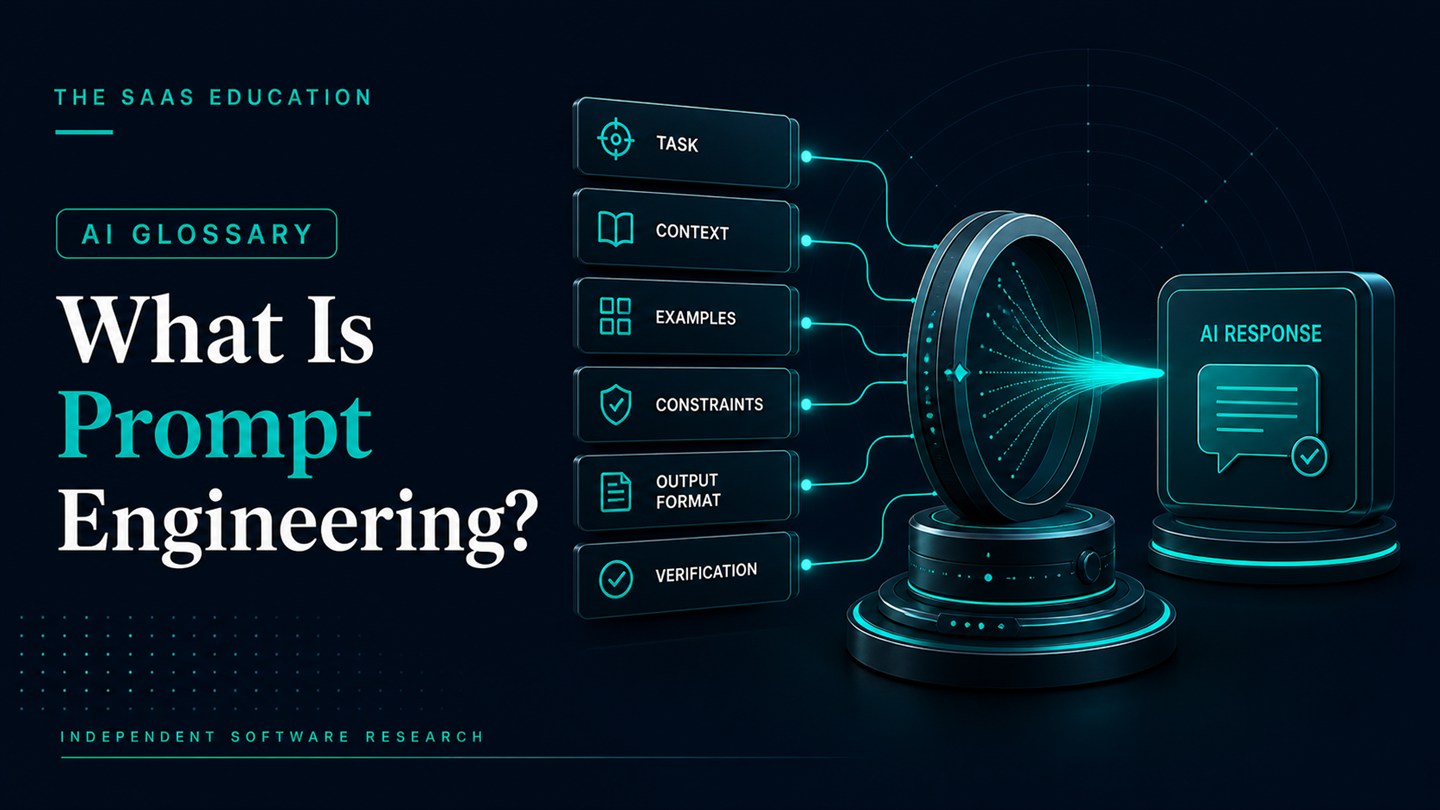
Prompt engineering is the practice of designing and testing the instructions, context, examples, constraints, and output format given to an artificial intelligence system so it can complete a task more usefully and reliably.
It is not a guarantee that the AI will be correct. It is a method for making the task clearer, reducing ambiguity, and creating a repeatable way to evaluate the result.
Why prompt engineering matters
AI systems can respond differently depending on how a task is framed. “Write about CRM” gives little information about audience, purpose, evidence, format, or success. A structured request can specify that the reader is a small-business buyer, the goal is to compare implementation risks, claims must use approved sources, and the output should be a decision table followed by limitations.
That additional structure helps the model choose a more relevant response. It also makes review easier because the expected result is explicit.
Prompt engineering matters most when the output enters a real workflow: customer support, software development, research, marketing, analysis, or internal operations. Poorly defined instructions can create inconsistent work, unsupported claims, privacy risk, and hidden review costs.
The main parts of a prompt
A useful prompt can include:
- Task: what the system should do.
- Context: information needed to understand the situation.
- Audience: who will use or read the result.
- Evidence: approved material the system may rely on.
- Constraints: facts, policies, tone, scope, or actions to avoid.
- Output format: prose, table, JSON, checklist, code, or another structure.
- Success criteria: how the result will be judged.
- Uncertainty rule: what to do when information is missing.
Not every task needs every element. The goal is sufficient clarity, not the longest possible instruction.
A prompt engineering example
A weak request might be:
Compare two project management tools.
A stronger request might say:
Compare Tool A and Tool B for a 25-person agency managing client projects. Use only the attached official pricing and documentation. Evaluate onboarding, guest access, workload planning, reporting, integrations, security controls, and annual cost assumptions. Mark unverified facts as unknown. Start with a decision table, then explain who should choose each tool and when neither is suitable.
The stronger version defines the audience, evidence, criteria, uncertainty behavior, and format. It still requires fact-checking because the model can misunderstand a source or make an unsupported inference.
Prompt engineering versus ordinary instructions
Prompt engineering becomes more systematic than ordinary instruction writing when teams test variants, document results, reuse templates, control source material, and evaluate outputs against defined criteria.
For a one-time low-risk task, a short instruction may be enough. For repeated or high-impact work, prompts should be treated like process assets: versioned, tested, reviewed, and updated when the model or workflow changes.
Prompt engineering and context engineering
The term prompt engineering is sometimes used broadly, but modern AI workflows often involve more than the visible user message. The system may receive policies, conversation history, retrieved documents, tool descriptions, structured data, and application state.
Context engineering refers more broadly to deciding what information and capabilities the model receives at each step. Prompt wording remains important, but source selection, retrieval quality, permissions, and workflow design can matter more.
Best practices
Define the job before the wording
State the outcome the user needs. A prompt cannot fix a task that has no clear purpose.
Supply relevant evidence
Provide authoritative, current material for factual work. Tell the system to distinguish verified facts from inference and unknowns.
Use explicit constraints
Name important boundaries, such as not exposing personal data, not inventing prices, and not taking an external action without approval.
Request a verifiable format
Tables, claim ledgers, source references, test cases, or structured fields can make errors easier to detect than a long unstructured answer.
Test with difficult examples
Evaluate the prompt on ambiguous, incomplete, and edge-case inputs. A prompt that works only on the ideal example is not production-ready.
Keep human review proportional to risk
Low-risk brainstorming needs less control than financial analysis, security advice, customer communication, or public factual content.
Common mistakes
- Adding excessive instructions that conflict with one another.
- Asking the model to “be accurate” without providing evidence.
- Treating a confident response as a verified response.
- Reusing one prompt across different models without testing.
- Hiding missing information instead of allowing an “unknown” result.
- Optimizing wording while ignoring source quality and workflow design.
- Using private data without an approved policy and environment.
How to evaluate a prompt
Create a small set of representative tasks and score the output for accuracy, completeness, relevance, format compliance, safety, consistency, and review effort. Record the model, version, settings, tools, and date.
Measure task completion rather than style alone. A fluent answer that requires extensive factual correction is less useful than a concise answer that is easy to verify.
Final takeaway
Prompt engineering is disciplined instruction and context design for AI systems. Its purpose is to improve task clarity, repeatability, and evaluation—not to remove the need for evidence or human judgment.
The strongest prompts define the job, provide trusted context, set boundaries, specify a usable output, and make uncertainty visible.
FAQs
Is prompt engineering a technical skill?
It can be used by non-technical users, while advanced systems may require knowledge of APIs, retrieval, tools, schemas, testing, and security.
Do longer prompts work better?
Not automatically. A prompt should contain the information required for the task without unnecessary or conflicting instructions.
Can examples improve a prompt?
Examples can clarify expected structure and judgment, but they should represent the actual task and not encourage copying unsupported content.
How often should prompts be updated?
Review them when the model, source data, product workflow, policy, or observed failure patterns change.
Is prompt engineering enough for reliable automation?
No. Reliable automation also needs source control, permissions, validation, monitoring, error handling, and appropriate human approval.
Sources
- OpenAI prompting guidance
- Anthropic prompt engineering overview
- Google prompt design strategies
- NIST AI Risk Management Framework
Sources checked August 24, 2026.
Frequently asked questions
What is prompt engineering in simple terms?
Prompt engineering is the practice of structuring instructions, context, examples, constraints, and output requirements so an AI system can perform a task more reliably.
Is prompt engineering only about wording?
No. It can include source context, examples, tool permissions, output schemas, evaluation criteria, and a workflow for checking the result.
What makes a good prompt?
A good prompt states the task, relevant context, constraints, expected output, and success criteria without unnecessary or conflicting instructions.
Can prompt engineering prevent AI errors?
It can reduce some errors but cannot guarantee accuracy. Important outputs still require verification against reliable sources or tests.
Do prompts work the same across AI models?
No. Models, versions, system instructions, tools, and context limits differ, so prompts should be tested in the actual environment.