What Is Retrieval-Augmented Generation (RAG)? Definition, Examples, and Why It Matters
Learn what retrieval-augmented generation means, how RAG works, where businesses use it, its benefits and limitations, and how it differs from fine-tuning.
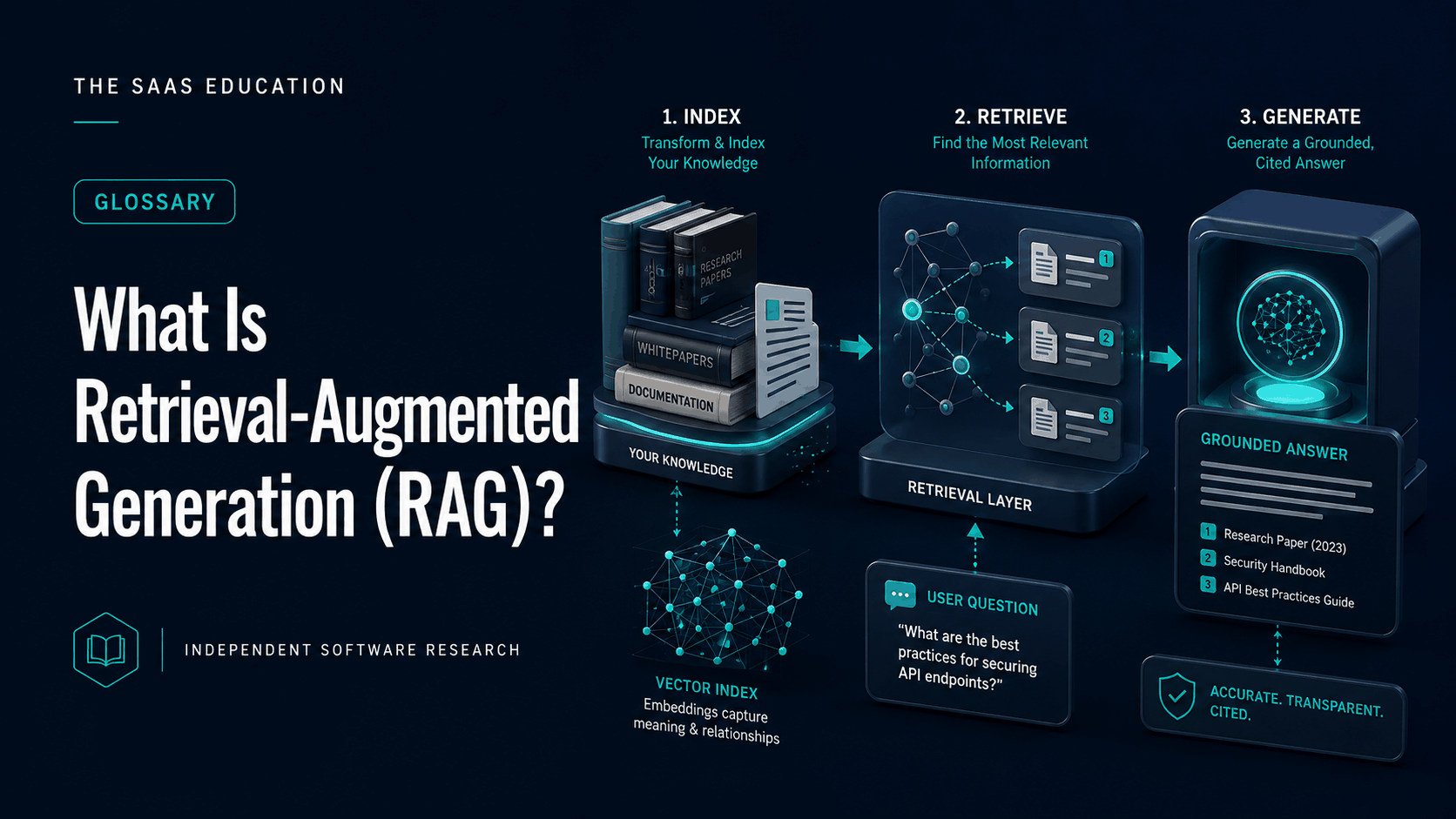
Definition
Retrieval-augmented generation, or RAG, is an AI approach in which a generative model receives information retrieved from an external source before producing an answer. The retrieved passages augment the user’s question, giving the model context beyond what is stored in its trained parameters.
NIST describes RAG as a type of generative AI system that pairs a model with a separate information-retrieval system or knowledge base. The system identifies relevant information for a query and provides it to the model as context. This can update the information available to an answer without retraining the model.
How RAG works
A basic RAG workflow has three visible stages:
- Retrieve: Search a collection for passages relevant to the question.
- Augment: Add those passages, instructions, and the question to the model’s context.
- Generate: Produce an answer using the retrieved context and the model’s language capabilities.
Production systems include more work. Documents may be cleaned, divided into chunks, labelled with metadata, converted into embeddings, indexed, permissioned, and refreshed. A query may be rewritten, searched through keyword and semantic methods, reranked, filtered, and checked before selected passages reach the model.
RAG does not require a vector database. A system can retrieve from keyword search, relational databases, APIs, knowledge graphs, document stores, web search, or a hybrid of several methods. Vector search is common because it can find conceptually similar passages even when wording differs.
Simple business example
Imagine an employee asks, “How much parental leave is available in India?” A general language model might answer from training data or guess from similar policies. A company RAG assistant first searches approved HR policies, filters by country and effective date, retrieves the relevant passage, and gives it to the model.
The model can then produce a concise answer with a link to the policy. The answer is useful only if the system retrieved the correct current document, respected the employee’s access, preserved important conditions, and cited the supporting passage.
Why RAG matters
Language models cannot contain every current, private, or organization-specific fact in their parameters. RAG provides a practical way to use product documentation, policies, research, support articles, contracts, account records, or current web information at answer time.
It can improve relevance, make updates faster than retraining, and provide sources for review. It can also limit an assistant to an approved knowledge collection. These benefits make RAG common in enterprise search, support, research, and knowledge-assistant projects.
However, RAG does not automatically make an answer true. A source link proves that something was retrieved, not that the source is authoritative or that the generated claim accurately reflects it.
Common RAG use cases
- Internal knowledge assistants: answer questions from policies, procedures, and documentation.
- Customer support: retrieve approved help content before drafting a response.
- Research: find and synthesize relevant papers, reports, or current pages.
- Legal and compliance discovery: locate clauses, controls, or policy evidence for qualified review.
- Product documentation: answer technical questions using current manuals and release information.
- Sales and account work: retrieve approved CRM, product, and public information for a brief.
RAG limitations
RAG systems can fail before generation begins. The required document may be missing, stale, inaccessible, poorly scanned, incorrectly chunked, or ranked below less relevant material. Ambiguous queries can retrieve the wrong product, country, customer, or policy version.
The model can also ignore context, combine incompatible passages, overgeneralize, or produce a claim that its citations do not support. Long context can add noise. More retrieved passages are not automatically better.
Permissions are critical. Retrieval must not expose a document merely because it is relevant. Access changes, deleted users, confidential folders, legal holds, geographic controls, and document-level permissions need to remain effective throughout indexing and answer generation.
RAG versus fine-tuning
RAG adds information at inference time. Fine-tuning trains a model further to change its behavior, style, format, or task performance. Fine-tuning is not the most direct way to keep frequently changing facts current, while RAG does not by itself teach a model a durable new behavior.
The methods can be combined. A fine-tuned model can follow a specialized response format while RAG supplies current evidence. Prompting and long-context document input are additional options; the correct architecture depends on scale, freshness, security, cost, and evaluation results.
How to evaluate RAG
Build a test set containing ordinary questions, ambiguous wording, missing answers, outdated documents, conflicting sources, and permission boundaries. Measure whether the correct evidence appears in the top retrieved results and whether the final answer is supported by that evidence.
Useful measures include retrieval recall, ranking quality, citation support, answer correctness, refusal when evidence is absent, latency, cost, permission failures, freshness, and reviewer acceptance. Evaluate retrieval and generation separately so teams know which component caused an error.
Assign owners for source collections. They should manage inclusion rules, metadata, access, refresh schedules, archived content, and deletion. Without content governance, a technically strong RAG pipeline can become a fast interface to an unreliable knowledge base.
Key takeaway
RAG connects generative AI to external knowledge at answer time. It can make responses more current, specific, and reviewable without retraining the model. Its quality still depends on trustworthy sources, effective retrieval, correct permissions, careful generation, and continuous evaluation.
Sources
- NIST CSRC definition of retrieval-augmented generation
- Original RAG paper
- Google Cloud RAG explanation
- AWS RAG explanation
- Stanford HAI RAG definition
Frequently asked questions
What does RAG stand for?
RAG stands for retrieval-augmented generation: retrieving relevant external information before a model generates its answer.
Does RAG stop AI hallucinations?
No. It can improve grounding, but bad retrieval, weak sources, and incorrect synthesis can still produce unsupported answers.
Does RAG require a vector database?
No. Systems may use vector, keyword, database, API, graph, or hybrid retrieval.
How is RAG different from fine-tuning?
RAG supplies external context at answer time. Fine-tuning changes model behavior through additional training.
What is a common RAG example?
An internal assistant that retrieves the current approved company policy before answering an employee’s question is a common example.
What makes a RAG system trustworthy?
Reliable sources, strong retrieval, enforced permissions, supported citations, safe behavior when evidence is missing, and continuous evaluation are essential.
Frequently asked questions
What does RAG stand for?
RAG stands for retrieval-augmented generation. A system retrieves relevant external information and supplies it as context to a generative model before the model creates an answer.
Does RAG eliminate hallucinations?
No. It can improve grounding, but retrieval may miss, rank, or chunk information badly, and the model can still misread or overstate the retrieved material.
Does RAG require a vector database?
No. Vector search is common, but retrieval can also use keyword search, databases, APIs, graphs, or hybrid methods.
What is the difference between RAG and fine-tuning?
RAG supplies external context at answer time, while fine-tuning changes model behavior or parameters through additional training. They solve different problems and can be combined.
What are common RAG examples?
Examples include internal knowledge assistants, support-answer drafting, policy search, research tools, product documentation assistants, and contract or case discovery.
How should a company evaluate a RAG system?
Test retrieval relevance, claim support, permissions, freshness, citation quality, latency, cost, failure handling, and the percentage of answers accepted after review.